
For Indian CA firms
The verifiable AI for Chartered Accountants.
Notice replies, legal research, bookkeeping, Tally sync and GST reconciliation — one login, one annual price. Every figure is checked before it posts, and every legal reference opens to the source.
DPDP-aligned·Encrypted at rest and in transit·Never trained on client data·Upload-only intake·Built in India for Indian CAs
One tool for the work your firm already does.
Notices and research
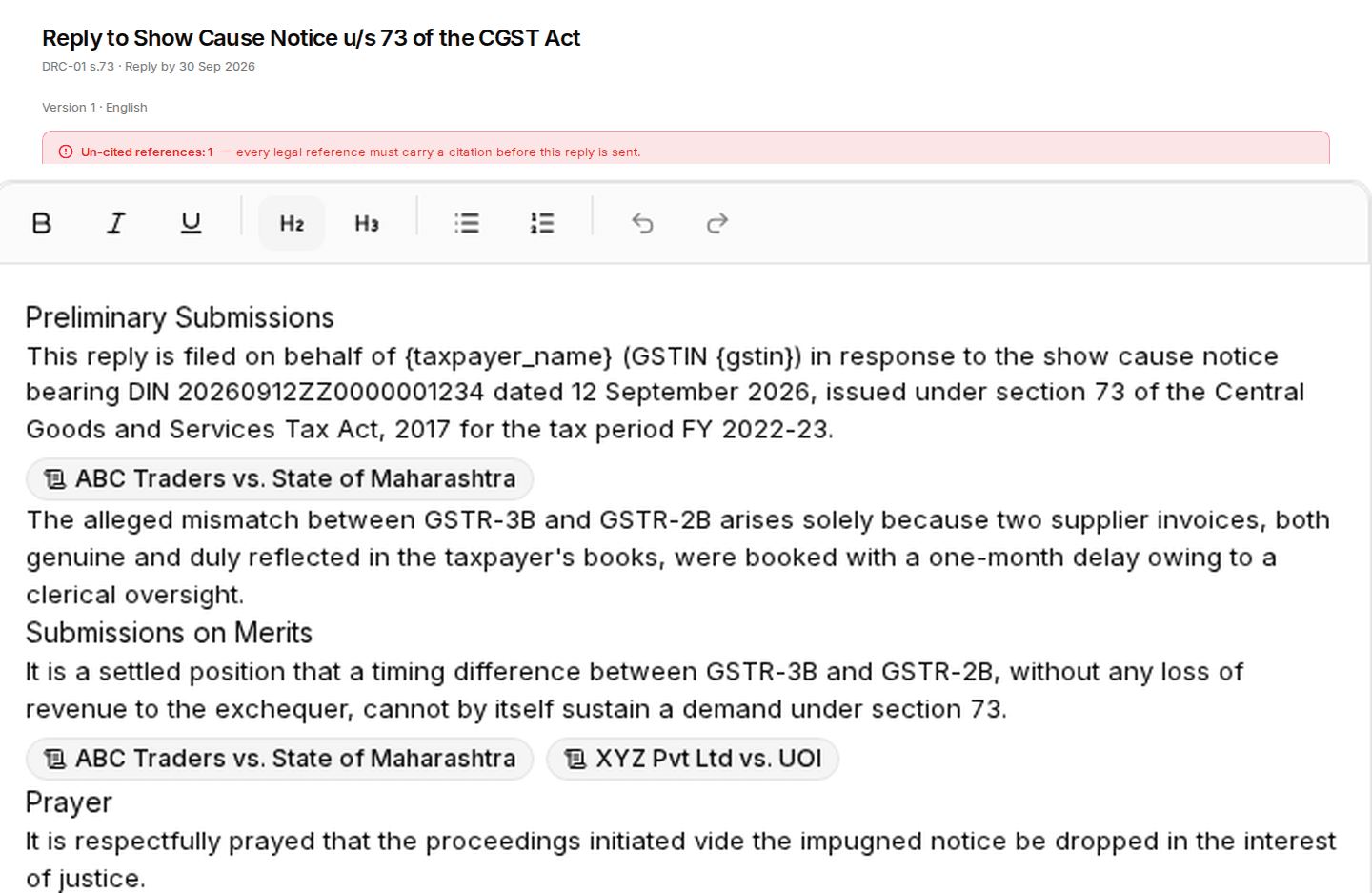
Upload a notice. Get a reply you can check, edit and send — every citation opens to the actual section, circular or judgment.
Books
Upload statements and invoices. Review the vouchers Charter AI prepares. Send them to Tally without typing.
GST
Match GSTR-2A/2B with your books. See only the entries that need attention before you file.
One login. One annual price. The whole practice.
How it works
- 1
Upload the notice
A PDF, or just type the facts of the matter. Charter AI reads the notice type, section, form, DIN/RFN, amounts and reply deadline automatically.
- 2
Statute-first research
Sections first, then CBDT/CBIC circulars, then case law from Indian Kanoon. Every source is cached with a link — never a web-search snippet standing in for law.
- 3
A cited draft you can edit
A Word-quality editor with citation chips inline. Any un-cited reference is flagged and blocks export until you've checked it. Download as .docx when it's ready to file.
Notices
Notice replies with cited law.
Income-tax scrutiny, GST demand and TDS mismatch notices, drafted by reference from your own past replies. Every legal reference carries a citation chip, and an un-cited reference blocks export until you've checked it. The same drafting workspace handles TM-A filings and examination-report objection replies.
See a cited draft →Research
Legal research, statute-first.
Ask a question in plain language. Charter AI runs the section first, then circulars, then case law from Indian Kanoon — ranked by court hierarchy, not by however a web search happened to order them. Every source is cached with a link before it's ever shown to you.
Ask a question →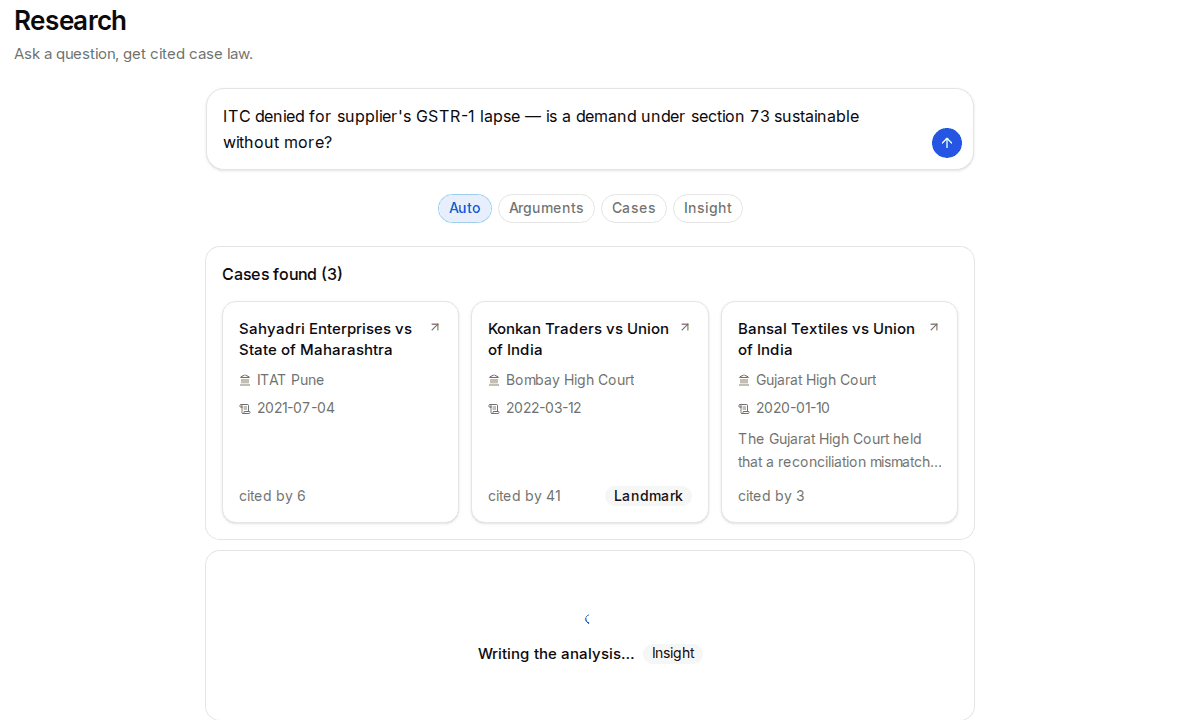
Books
Bank statements to Tally vouchers.
Upload a bank statement — PDF, scan or photo. Charter AI reads it, classifies the transactions and prepares the vouchers. Your team reviews what it's proposed and approves. Nothing posts until the totals match and someone says yes.
See bookkeeping →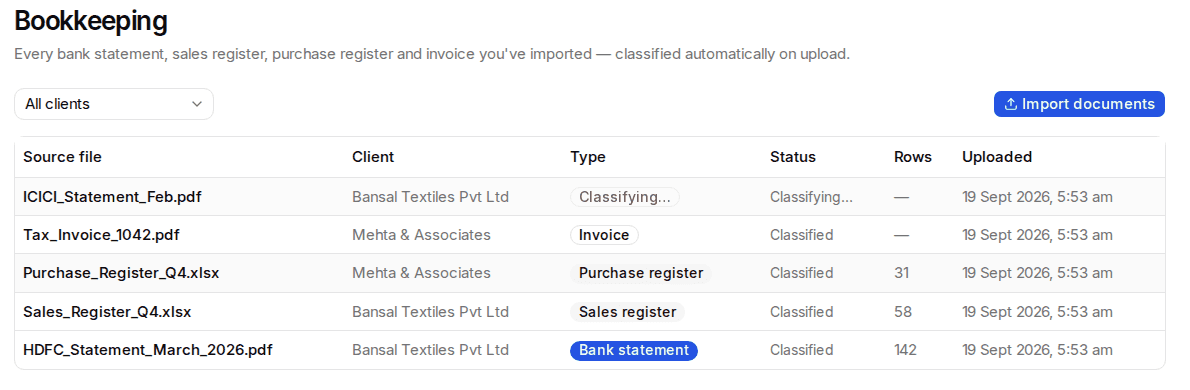
Books
Invoices and registers, in any format.
Sales registers, purchase registers and individual invoices — PDF, JPG, PNG, XLSX or CSV, one file or a whole month at once. Pick the client, drop the files, and each one is classified as it arrives.
Import a document →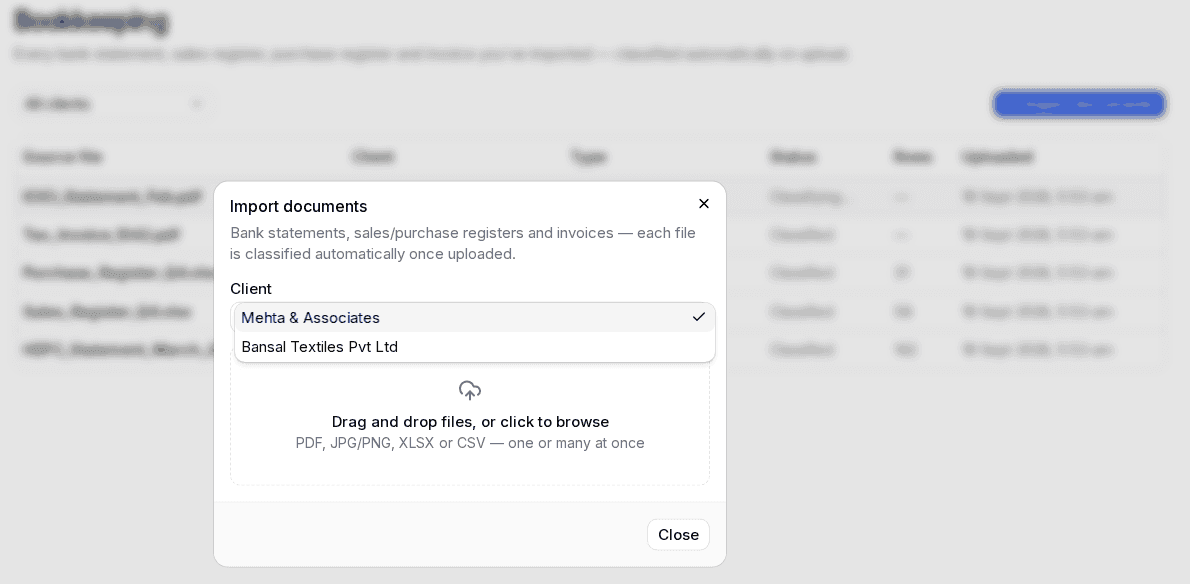
Books
Ledger suggestions that learn.
It learns how your firm maps ledgers. Checking gets faster every month.
See how it works →Every approval refines the next suggestion for that client.
Books
Tally stays your books.
Approved vouchers post straight into TallyPrime. Charter AI stops the re-typing — Tally stays the ledger of record your firm already trusts.
See how it works →Nothing posts until a deterministic balance check passes.
GST
GST reconciliation.
Match GSTR-2A/2B with your books. See only what needs attention. Problems surface before you file, not after a notice arrives.
See how it works →A mismatch list to work through, not a spreadsheet to build.
Calendar & vault
Every due date, and every document, in one place.
GSTR, TDS and ITR due dates populate automatically from each client's registration type. Documents land in a PAN- and GSTIN-linked vault, encrypted and searchable, tagged and auto-classified as they arrive.
See the calendar →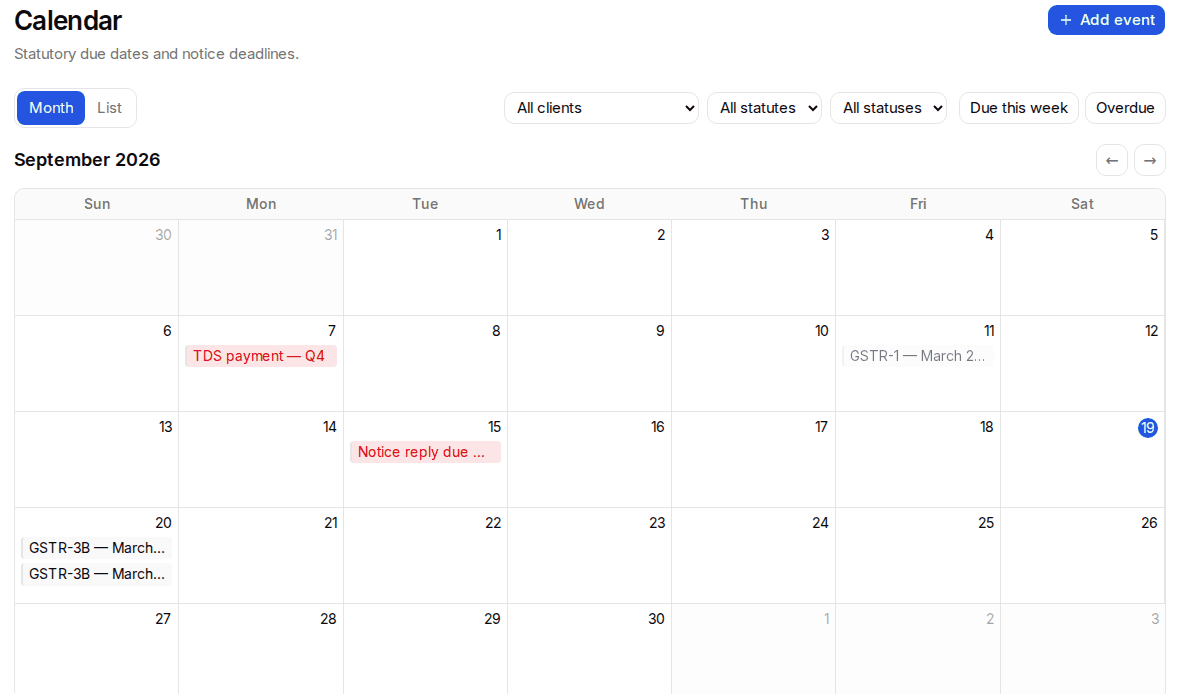
Built around how your practice actually runs, whatever size it is.
Sole practitioner
One login, everything on it. Draft notice replies, research case law and reconcile a client's books yourself, without a full-time associate — the compliance calendar keeps every due date in view while you're heads-down on a scrutiny case.
Partner with staff
Your team's data entry, your reconciliations and your notices, in one place. Statements and invoices come in, vouchers go to Tally, and the notice replies and research that only a partner can sign off still run through the same login.
Growing client roster
PAN- and GSTIN-linked client records, bookkeeping and a searchable document vault scale with your roster. Trademark TM-A filings and objection replies open a second billable line on the same subscription, no new software to buy.
Why not just use a general AI chatbot?
| A general AI chatbot | Charter AI | |
|---|---|---|
| Getting the facts in | You retype the notice, or paste and hope | Reads the notice PDF: type, section, form, DIN/RFN, amounts and deadline |
| How research runs | One answer, instantly, in whatever order it likes | Statute first, then circulars, then case law |
| Sources | Citations you have to verify yourself, some of which do not exist | Every reference opens to the cached source; un-cited references block export |
| Where the work lives | A chat window | A notice workspace with versions, flags and Word export |
| Your client history | None | PAN- and GSTIN-linked records, past replies reusable as reference |
AI can make mistakes. Charter AI is built to make review easier, not to remove it.
Charter AI vs a data-entry-only tool
Tools that stop at data entry serve your articles. Charter AI serves that work and the partner’s — and where it collects client documents, it does it by direct upload into a vault, not over WhatsApp.
| Data-entry-only tools | Charter AI | |
|---|---|---|
| Data entry into Tally | Yes | Yes |
| GST reconciliation | Yes | Yes |
| Client document collection | Usually WhatsApp | Direct upload into a per-client vault |
| Notice replies with cited law | No | Yes |
| Legal research with linked sources | No | Yes |
| Trademark filings and objection replies | No | Yes |
| Compliance calendar | No | Yes |
| Sources you can open and check | No | Yes — every citation |
Your clients trusted you with this. We built for that.
A GST demand notice or a scrutiny file carries a client’s financials, PAN and GSTIN. It stays inside your firm’s account — nothing is repurposed, nothing is public. Your clients’ statements, invoices and notices stay inside your firm’s account.
Encrypted at rest and in transit, on infrastructure you don't have to manage.
DPDP-aligned by design: client data is never sold and never reused to train or generate content for anyone else.
No inbound email. Every document enters through the app, under your control — nothing arrives unattended in an inbox.
One plan. Near-unlimited use across the practice.
A fixed annual fee, priced against what a partner’s hour costs — not against how many drafts you run. Fair usage applies, and the pricing page sets out exactly what that means. See the fair-usage detail.
- Notice replies and legal research
- Bookkeeping automation
- Tally sync
- GST reconciliation
- Compliance calendar
- Client and document vault
- Trademark filings and objection replies
- Word and PDF export on every draft
- 7-day trial, no card
Frequently asked questions
How accurate is it — can I trust the citations?
Every legal reference in a draft carries a citation back to a source in our cache, and that source is only citable once it has a real URL and a fetch timestamp — a web-search snippet is never treated as a source. Before a draft can be exported, any un-cited reference is flagged and has to be checked off. You’re always reading the underlying section, circular or judgment yourself, not taking the model’s word for it.
What happens after the 7-day trial?
The trial needs no card and includes 1 notice draft, 2 research queries and about 4 other AI-assisted uses (trademark drafting, objection replies, notice intake). The annual plan replaces those trial caps with a near-unlimited allowance — see pricing for the exact shape of it.
Do you handle bookkeeping and data entry too?
Yes. Upload statements and invoices, review the vouchers, approve them. Approved vouchers post to TallyPrime. Nothing posts without your approval. It runs on the same subscription as notice drafting, research, the compliance calendar, the client vault and trademark filings.
Do you do GST reconciliation?
Yes. Upload or pull GSTR-2A/2B and Charter AI matches them against your books, with a mismatch list to work through.
How is this different from a bookkeeping-only tool?
Bookkeeping tools serve the data-entry desk. Charter AI serves that work and the partner’s: notice replies with cited law, legal research, trademark filings, a compliance calendar and a client document vault. Every legal reference opens to the source, so you can check it yourself rather than trust it. Where it collects client documents, it does so by direct upload into a per-client vault rather than over WhatsApp.
What counts as fair usage?
The annual plan is sized for a normal practice’s real usage, not metered per draft. The pricing page states the allowance in plain numbers.
Can I export to Word?
Yes — every draft exports as a real .docx file with headings, numbering and formatting intact, ready to put on your firm’s letterhead and file, or as a PDF with the same layout.
Is my clients' data private?
Yes. Client documents, facts and research queries are never made public, never sold and never reused to generate anyone else’s content — read the full privacy policy.
Which notices does this handle?
Income-tax scrutiny under sections 143(2), 148 and 142(1); GST demand notices (DRC-01, ASMT-10) and TDS mismatch notices, plus trademark TM-A filings and examination-report objection replies.
Try Charter AI on one client.
Run one client’s statements, one reconciliation and one notice reply. Decide after that.
No card needed. You review everything before it is filed.