
Sale Deed Draft in India: Key Clauses and Registration
Learn how to create a sale deed draft in India with essential clauses, legal requirements, and registration steps to protect your property transaction.
Published 16 min read

Drafting a sale deed isn't about filling a template. It's a seven-stage workflow that should reach zero unresolved identity, title, boundary, consideration, or annexure mismatches before execution.
You may already have the seller's earlier deed, the buyer's identity documents, a payment schedule and a registration appointment under discussion. The difficult part is making those records agree with the document everyone intends to sign. A polished draft won't resolve an unexplained boundary change, an unsupported claim of ownership or a stamp calculation borrowed from another state.
Table of Contents
- Why a Sale Deed Draft Is More Than a Template
- Build the file through controlled stages
- Separate agreement from verification
- Gathering Parties, Property, and Consideration Details
- Party identity and authority
- Property identity and the payment trail
- The Operative Clauses Every Draft Should Carry
- Establish the transaction before stating promises
- Allocate risks rather than hiding them
- Make completion obligations usable
- Stamp Duty and Registration Mechanics by State
- Separate the financial check from presentation readiness
- Control the execution date
- Digital and Paperless Registration Workflows
- Distinguish proposals from available procedures
- Prepare a digital submission pack
- Pre-Execution and Post-Registration Checklists
- Drafting and Registration Review Checklist
- Close the file beyond presentation
- Closing Habits That Make a Sale Deed File Audit-Proof
- Preserve decisions, not just documents
Why a Sale Deed Draft Is More Than a Template
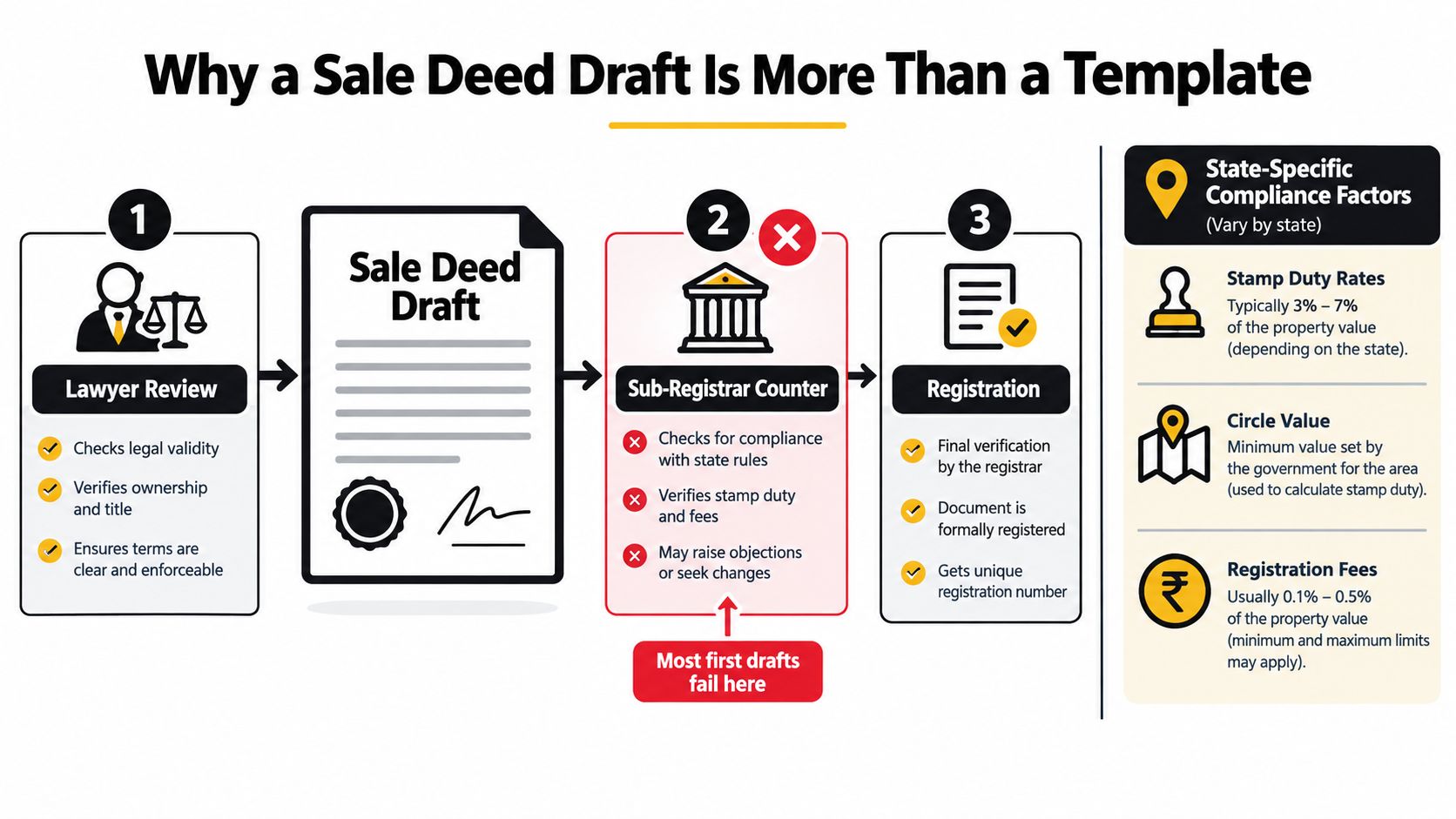
A sale deed draft is a state-specific compliance document. The parties' agreement matters, but so do the property records, valuation method, supporting enclosures and requirements of the competent Sub-Registrar.
Use a precedent for structure, not for facts. Retain a clause only after checking that it describes this transaction and that the file supports what it says.
Build the file through controlled stages
The drafting sequence should follow these seven controlled stages, with Delhi's official guidance providing the supporting registration requirements for jurisdiction, documents, appearance and attestation of alterations: Delhi Revenue's registration FAQ.
- Identify jurisdiction. Establish the competent Sub-Registrar from the property's location before arranging presentation.
- Verify title and authority. Review the seller's title chain, prior conveyances, tax records, encumbrance position, approved map or plan, and authority to sell.
- Fix the legal description. Capture the survey or plot number, boundaries, area, municipal details and undivided share where relevant.
- Validate valuation and duty. Apply the relevant state valuation method to the transaction rather than copying an earlier calculation.
- Draft operative obligations. Address payment, possession, warranties, encumbrances, indemnity, taxes, mutation, document handover, default and jurisdiction.
- Reconcile clauses with evidence. Compare each material statement against the document supporting it.
- Execute and register. Manage signatures, witnesses, presentation and the applicable statutory window as controlled closing tasks.
The registration counter is an important review point, but it shouldn't be where the team first discovers inconsistencies.
Separate agreement from verification
The buyer and seller may agree commercially while their documents remain inconsistent. Treat those as different workstreams: negotiation settles what the parties intend; verification establishes whether the draft accurately records it.
Practical rule: If a material statement has no supporting record, mark it for resolution rather than making the language sound more certain.
Maintain a query register alongside the draft. Record the disputed detail, the evidence needed, the responsible person and the resolution. That's more useful than leaving a vague comment asking the junior to “please check”.
Gathering Parties, Property, and Consideration Details
Start with a transaction data sheet, not the recital page. Keep separate records for party identity, property identity and consideration, then bring the verified information into the draft.
This approach makes disagreements visible. A name discrepancy belongs in an identity query; an inconsistent survey reference needs property-record reconciliation. Neither should disappear into a general “documents pending” note.
Party identity and authority
Capture the parties' full legal names, addresses, identity particulars, photographs and representative details. Where the applicable form asks for parent or spouse particulars, check them against the supporting records rather than relying on an informal client message.
Compare PAN, Aadhaar or other accepted identity records with the names appearing in prior conveyances. Don't standardise a spelling difference and assume the reviewer will understand it.
- Name variations: Record the difference and obtain an appropriate explanation or supporting document.
- Representative capacity: Examine the authority to execute, present and admit the document, rather than merely recording the representative's name.
- Address differences: Distinguish an old address in the title record from the current address used for identification.
- Witness readiness: Collect the particulars required by the relevant registration procedure before finalising the execution set.
For a CA firm, the practical division of work matters. Staff can organise and compare records; unresolved questions about ownership or authority should go to the legal reviewer.
Property identity and the payment trail
Prepare a property comparison sheet showing what appears in the prior deed, current records, approved plan and proposed schedule. Include survey or plot references, boundaries, area, municipal identifiers and undivided share wherever relevant.
Don't choose whichever description looks newest. If a survey reference has changed or an area differs, ask for the record explaining the change. Built-up, super-built-up and land areas shouldn't be treated as interchangeable descriptions.
The consideration sheet should distinguish:
- Agreed price: The commercial consideration the parties have settled.
- Valuation basis: The circle or guideline value and applicable state method.
- Payment evidence: Receipts and banking records supporting amounts already paid.
- Outstanding obligations: Payments still due and the agreed conditions for release.
A payment table is often clearer than a long receipt paragraph. It lets the reviewer compare the draft's acknowledgement with the actual trail without assuming that “paid in full” is harmless boilerplate.
Keep the tax review separate from the registration computation. Consult the section 50C statutory text when assessing valuation-related tax questions; don't assume that the amount accepted for drafting resolves every tax issue.
The Operative Clauses Every Draft Should Carry
The operative clauses should explain what is transferred, what has been paid, what remains to be done and who bears each identified risk. Long legal language isn't a substitute for those answers.
A useful review technique is to ask what evidence supports each clause and what action follows from it. If neither is clear, the clause probably needs revision.
Establish the transaction before stating promises
Title, parties and recitals. Identify the transaction and explain how the seller acquired the interest proposed to be sold. Recitals should follow the verified title chain, not a copied ownership narrative. Definitions help where the property, annexures or parties recur throughout the document.
Sale and conveyance. Describe the interest being transferred and connect it precisely to the property schedule. Avoid broad wording that appears to transfer rights the seller's documents don't establish.
Consideration and receipt. State the agreed consideration and distinguish completed payments from outstanding payments. An unconditional receipt acknowledgement is inappropriate when the supporting payment evidence is incomplete.
Possession. Specify the agreed handover position and any outstanding steps. If possession is deferred, identify the obligation and the evidence the parties will retain when handover occurs.
Allocate risks rather than hiding them
A title warranty should reflect the seller's verified position. Encumbrance wording should distinguish between a confirmation that none have been identified and a disclosed matter requiring discharge or another agreed treatment.
A warranty records a promise. It doesn't replace the title documents that justify accepting that promise.
Use the following drafting questions to test the remaining protections:
- Title and third-party claims: What does the seller confirm, and how will an undisclosed claim be handled? Don't assume a broad sentence automatically prevents claims by heirs or other persons.
- Indemnity: Which identified risks does it cover, what triggers responsibility, and how should the buyer notify the seller?
- Taxes and outgoings: What is the agreed allocation date, and who must clear earlier liabilities?
- Default and remedies: Which obligations remain outstanding, and what happens if a party doesn't perform them?
The trade-off is between readability and precision. Overloaded clauses can obscure the obligation; short generic clauses can omit the very risk the parties need to allocate. Use separate provisions where obligations involve different documents, dates or responsible persons.
Make completion obligations usable
Mutation and record updates should identify who applies, what cooperation is required and which documents must be supplied. Avoid promising an administrative outcome that the parties cannot themselves guarantee.
Original-document handover should refer to an inventory. Where an original won't be delivered, identify the document, the reason and the agreed arrangement instead of leaving a blanket acknowledgement.
Include a tax-compliance responsibility clause where the transaction requires one, but settle its wording after reviewing the applicable position. Don't insert a withholding statement solely because it appeared in the last property file.
Finally, check the jurisdiction clause, execution blocks, witness particulars and annexure references together. A complete body with an incomplete signing set is still an unfinished draft.
Stamp Duty and Registration Mechanics by State
Delhi provides a useful illustration of why the financial schedule must remain state-specific. Its published schedule lists stamp and transfer duty at 4% for a woman purchaser and 6% for a man purchaser, with a registration fee of 1% of the sale-deed value plus a ₹100 pasting charge; the corresponding procedural comparison should be checked against the official Telangana sale-deed registration guidance.
Those figures are a worked reference, not a standing instruction for another transaction. Obtain the current applicable schedule and confirm the transaction category, valuation basis and eligibility for any concession before approving payment.
Separate the financial check from presentation readiness
The finance reviewer and the person arranging registration need different working papers. Combining everything into a single “registration charges” figure makes it difficult to identify what was calculated, paid or left outstanding.
| Review area | Delhi illustration | What the file reviewer should establish |
|---|---|---|
| Stamp and transfer duty | Purchaser category affects the published rate | Current schedule and applicable category |
| Registration charges | Separate fee and pasting charge | Correct calculation and payment evidence |
| Supporting documents | Title and property enclosures accompany presentation | Complete enclosure set |
| Appearance and identification | Executant and identifying witnesses are required | Applicable identity and attendance requirements |
For another state, rebuild the calculation instead of substituting the property address into the Delhi sheet. A rate remembered from a previous matter isn't adequate support for the current file.
Control the execution date
Under the procedure reflected in the Telangana guidance cited above, a non-will document must be presented within four months of execution. Record the execution date, calculate the presentation deadline and assign an escalation owner when the document is signed.
Don't treat the last permissible date as the working target. Resolve attendance, authority and enclosure questions early enough to deal with an unsuccessful appointment.
The same guidance requires photographs and fingerprints of buyer and seller, address-proof copies for parties and witnesses, and presentation before the territorially competent Sub-Registrar. State procedures may allow appearance through a duly authorised agent, but the team must verify the authority and accepted process for the particular file.
- Jurisdiction check: Use the property location, not the parties' residential addresses.
- Identity check: Match the execution set with the supporting particulars.
- Payment check: Compare the duty calculation with the receipt and transaction data.
- Presentation check: Confirm attendance, witness arrangements and required enclosures.
A booking confirmation is an administrative milestone. It isn't evidence that the deed, valuation or title has passed substantive review.
Digital and Paperless Registration Workflows
A digitally prepared sale deed draft can still contain an unsupported ownership statement. Digitisation changes submission and verification processes; it doesn't remove the need for title review.
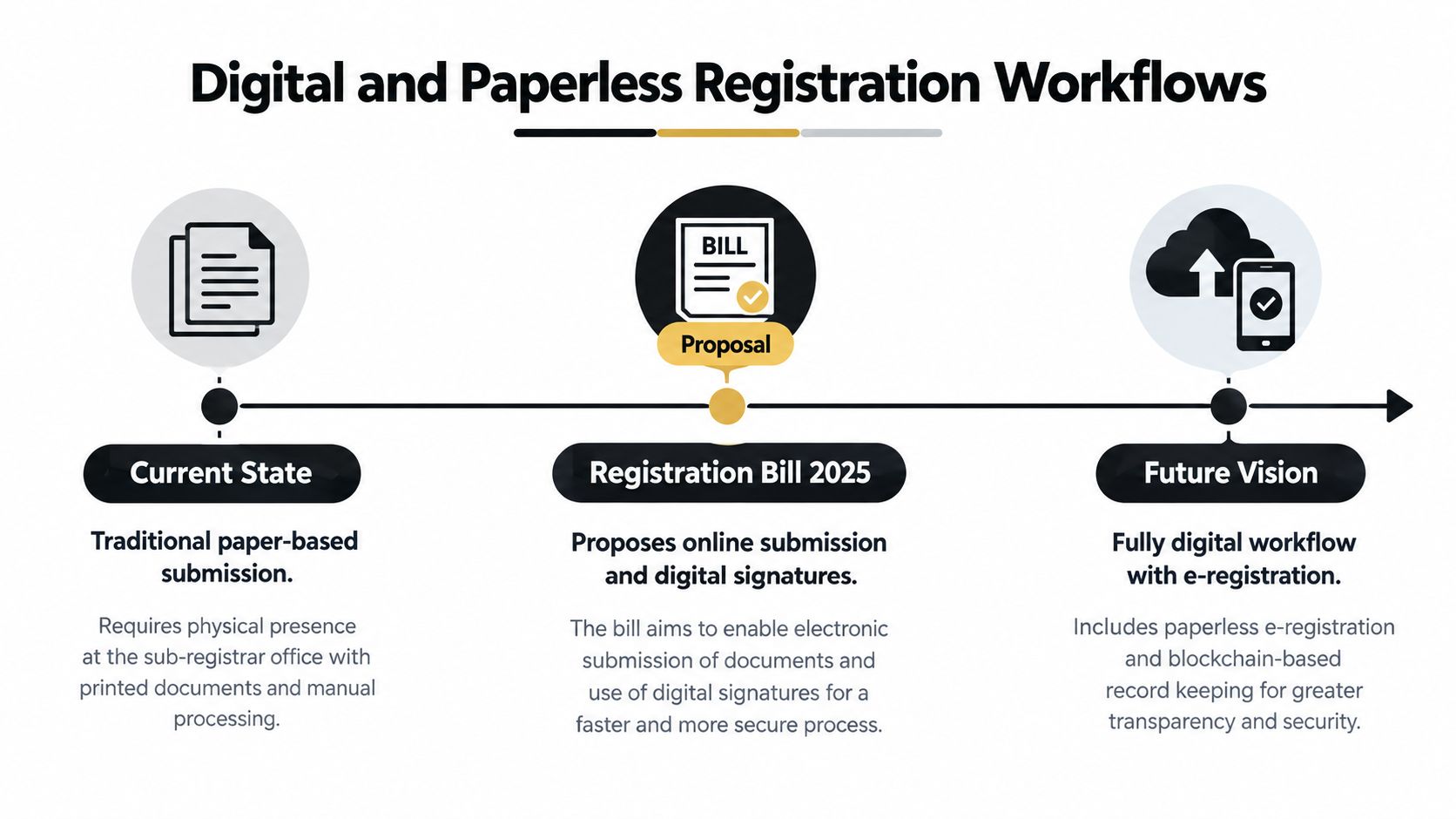
The reported Registration Bill 2025 proposals sought electronic submission, electronic admission and verification, digital registration certificates and broader mandatory registration, including agreements to sell and powers of attorney. Separately, Haryana announced a statewide paperless process from November 1, 2025, with OTP verification, guided forms, digital uploads, appointments, tracking and electronic transmission for mutation updates, as described in the overview of registration reforms and state workflows.
The visual below provides a transition map, not confirmation that every proposed feature is legally operative.
Distinguish proposals from available procedures
For a cross-state CA practice, maintain a state workflow note recording the current procedure, the source checked and any unresolved operational questions. Don't describe a proposed central reform as an available national filing route.
Likewise, an announced state rollout doesn't justify assuming that every document type, representative arrangement or exception can be completed through the same portal path. Confirm what applies to the transaction before advising the client to rely on it.
Consider a file where the signed draft uses an address format that differs from the identity record intended for portal verification. The drafting team shouldn't make an unexplained last-minute change merely to complete the online form. Reconcile the record, preserve the approved wording and document any necessary amendment.
Prepare a digital submission pack
The submission pack should distinguish the signed instrument from scans, identity records and supporting annexures.
- Identity mapping: Identify whose details require verification and which accepted records support them.
- Annexure control: Give uploaded files clear names and reconcile them with the deed's references.
- Verification exceptions: Establish the authorised response if OTP or biometric verification fails.
- Mutation follow-through: Confirm whether electronic transmission completes the next step or whether someone must make a separate application.
Keep a paper fallback ready where permitted, but don't improvise an unofficial alternative at the counter. Ask the relevant office what exception process it accepts.
Use the accompanying video as a discussion aid, not as a substitute for current official instructions.
Pre-Execution and Post-Registration Checklists
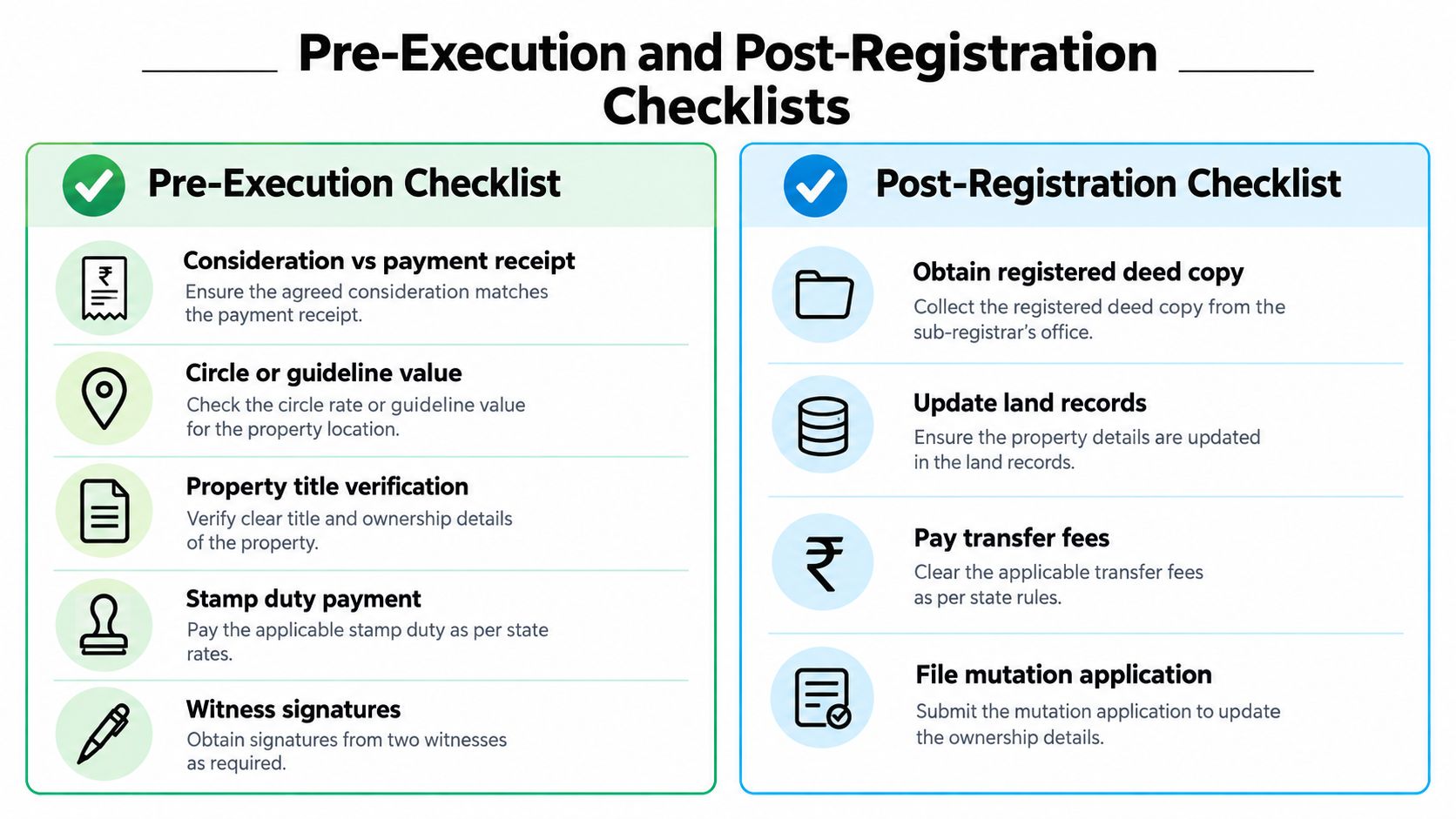
A checklist works only when it identifies evidence and responsibility. “Checked” is too vague if the reviewer can't see which record was examined or what remains unresolved.
Use the closing checklist as a control sheet, with links or references to the actual documents.
Drafting and Registration Review Checklist
| Stage | Verify | Evidence on File |
|---|---|---|
| Party review | Identity and authority agree with the draft | Identity records and authority documents |
| Title review | Ownership narrative matches the reviewed chain | Prior conveyances and title-review note |
| Property schedule | Description agrees with supporting records | Map or plan and property comparison sheet |
| Financial review | Consideration, valuation and payments reconcile | Calculation sheet, receipts and banking records |
| Execution readiness | Signing set and enclosures are complete | Approved draft and annexure index |
| Presentation control | Correct office and timely presentation | Jurisdiction note and deadline record |
| Post-registration | Registered document and follow-up tasks are tracked | Registered deed, acknowledgements and custody record |
Close the file beyond presentation
Before execution, have a reviewer compare the final signing version with the approved draft. Confirm that no annexure was dropped during printing or upload and that comments intended for internal review haven't survived into the execution set.
After registration, obtain and inspect the registered document, record custody of the original and retain a usable working copy. Assign responsibility for mutation or record-of-rights follow-up and property-tax updates rather than assuming the buyer will handle them.
- Tax review: Check the section 194-IA statutory text to determine applicable withholding and filing actions, then retain the relevant evidence.
- Record retention: Preserve payment support, handover acknowledgements and relevant vendor or witness declarations.
- Open-item tracking: Keep pending applications visible until the responsible person records completion or escalation.
Completion test: Registration closes the presentation task. Close the professional file only after documenting the remaining obligations and who will discharge them.
Closing Habits That Make a Sale Deed File Audit-Proof
No sale deed file is immune from challenge. The practical aim is a defensible audit trail that lets another reviewer reconstruct the transaction without relying on the original associate's memory.
Keep the approved draft under version control. Use a dated version name, preserve the reviewed redline and identify who authorised the signing copy. Don't allow an attachment circulated casually between parties to become the execution version without comparison.
Preserve decisions, not just documents
A folder full of PDFs doesn't explain why a discrepancy was accepted. Retain a short decision note for material issues, identifying the question, evidence reviewed, conclusion and approval.
- Resolve substantive questions: Obtain legal review where title, authority or competing claims remain uncertain.
- Control alterations: Apply the attestation requirements noted in the official guidance, including signatures or initials for blanks, erasures, interlineations or alterations.
- Separate process layers: Keep legal execution requirements distinct from portal upload instructions.
- Record exceptions: Preserve the accepted fallback procedure and any office communication relevant to its use.
Redline review belongs before signing, not during a hurried conversation at the registration counter. If the final document changes materially, pause and reconcile it again rather than assuming the earlier approval still applies.
The strongest closing habit is simple: make every important statement traceable and every unfinished task assignable. That supports tax review, mutation follow-up and any later examination of the transaction without pretending that careful drafting can cure defective title.
Charter AI offers Indian CA firms an AI-enabled workspace for source-linked tax research, drafting, document evidence traceability and compliance management. Visit Charter AI to explore how your team can organise the tax research, supporting records and compliance follow-up surrounding a sale deed file, while retaining state-specific legal review and professional sign-off.