
ITC Reversal as Per Rule 42: Formula and Worked Example
Learn how ITC Reversal as per Rule 42 works: exclusive and common credit formula, worked example, GSTR-3B reporting and journal entries.
Published 14 min read
You're closing the month, the purchase register is reconciled, and one question still blocks filing. How much credit do you have to give back because some inputs served exempt supplies as well as taxable ones? If you guess, you either reverse too much and lose credit you're entitled to, or reverse too little and invite a notice.
ITC reversal as per Rule 42 isn't difficult arithmetic. It's classification work followed by one proportion. Tag each invoice correctly first, and the calculation, the GSTR-3B row and the audit trail fall into place.
Table of Contents
- The Rule 42 Formula and Its Components
- Three Buckets Before Any Maths
- Telling Rule 42 Apart from Other ITC Reversals
- A Three-Question Check for Each Invoice
- How to Calculate the Reversal with a Worked Example
- Six Steps in Order
- Worked Example for One Period
- Year-End True-Up and Capital Goods Under Rule 43
- Capital Goods Don't Behave Like Monthly Inputs
- Reporting Rule 42 Reversals in GSTR-3B and Your Books
- Posting the Reversal in the Books
- Confirm Your Rule 42 Reversal Before You File
The Rule 42 Formula and Its Components
Rule 42 applies when you use inputs and input services partly for taxable supplies and partly for exempt supplies or non-business purposes. You can't keep credit that relates to exempt or non-business use, so you sort the credit before you calculate anything.
Three Buckets Before Any Maths
Put every invoice into one bucket. Exclusive taxable credit stays in full. Exclusive exempt credit, often called D1 in workings, is reversed in full because none of it supported a taxable supply. What's left is common credit, used for both kinds of supply, and only that bucket is reversed in proportion.
That proportion comes from turnover, not invoice count. A single large exempt sale changes your economics more than twenty small ones, so the rule uses value. Take exempt turnover (E) and total turnover (T) for the period, both excluding GST, and divide E by T.
| Component | What it covers | How it enters the formula |
|---|---|---|
| Exclusive taxable credit | Inputs used only for taxable supplies | No reversal |
| Exclusive exempt credit (D1) | Inputs used only for exempt supplies or non-business use | Reversed in full |
| Common credit (D2 base) | Inputs used for both taxable and exempt supplies | Reversed in proportion to E/T |
| Exempt turnover (E) | Exempt supplies for the period, excluding GST | Numerator of the ratio |
| Total turnover (T) | Taxable plus exempt turnover for the period, excluding GST | Denominator of the ratio |
| Threshold test | Whether E/T exceeds 5% | Reversal applies only above 5% |
Practical rule: Label the use on the invoice when you book it. Reconstructing use at month-end from memory is where buckets get mixed.
The plan for this working applies a 5% test. If E/T is at or below 5%, you don't reverse common credit for that period. Above 5%, you do. That test sits within section 17(2), and you should check the current Rule 42 text for the period you're filing.
Exports need care. They're zero-rated taxable supplies, so they count in T but not in E, and inputs used only for exports take no reversal.
The one-line result is this. Total reversal = D1 + (common credit × E ÷ T).
Telling Rule 42 Apart from Other ITC Reversals
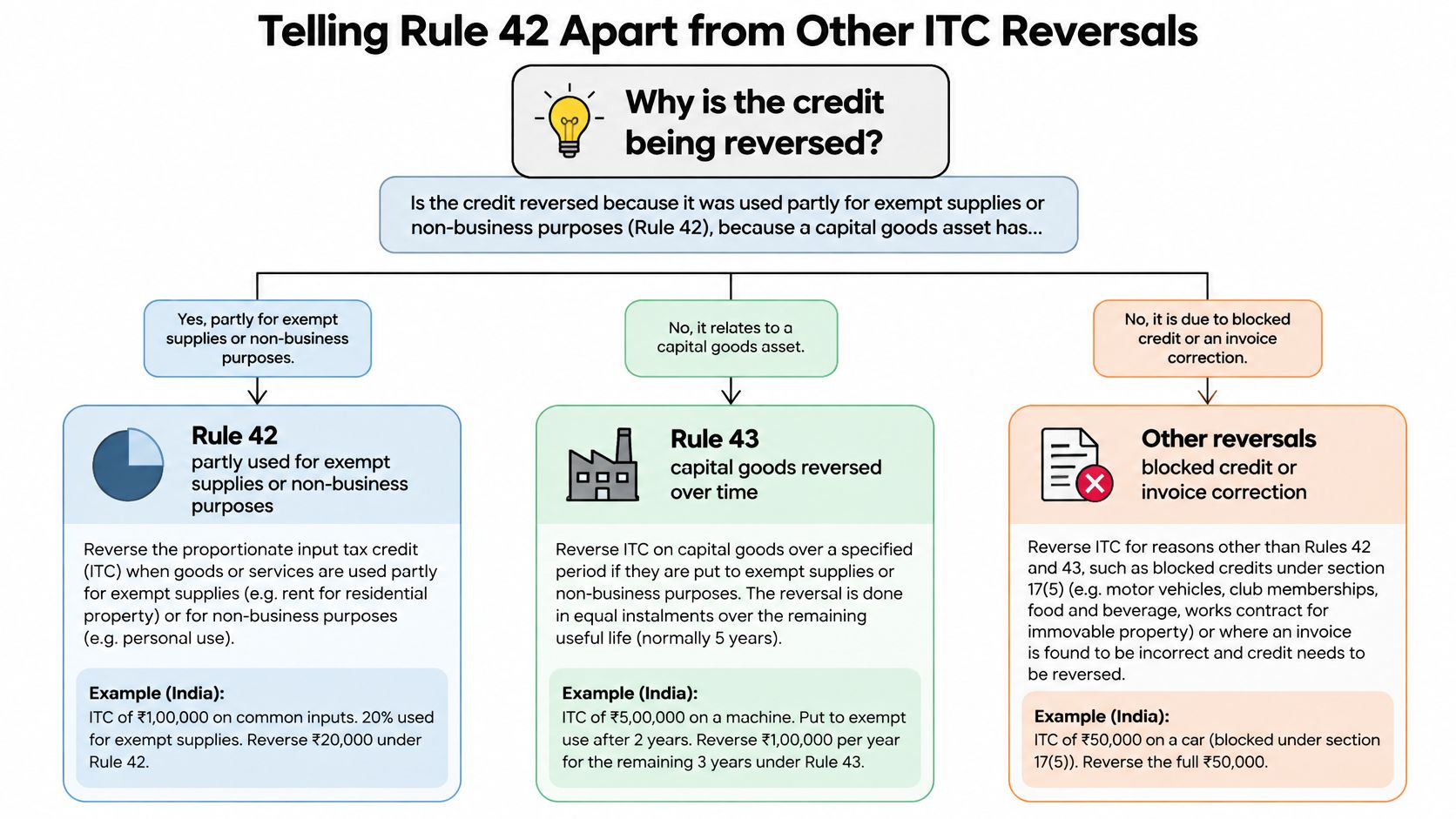
Start with one question. Why is this credit being reversed? The answer decides the provision, whether you can reclaim it later, and where it goes in GSTR-3B. Get that tag wrong and even perfect arithmetic produces a wrong return.
The CBIC text of Rule 42 covers inputs and input services used partly for taxable supplies and partly for exempt supplies or non-business purposes, and it requires you to separate exclusive credits, common credit and the business or non-business component first. Circular 170/02/2022-GST states that Rule 42 reversals that are absolute and non-reclaimable are reported in Table 4(B)(1).
A Three-Question Check for Each Invoice
Work through these in order and stop at the first clear yes.
- Mixed exempt or non-business use: Was the input or service used partly for exempt supplies or non-business purposes? That's Rule 42, unless it's a capital good.
- Capital goods with mixed use: Is it an asset you'll use over time for both taxable and exempt supplies? That's Rule 43.
- Payment or blockage: Was the supplier unpaid beyond 180 days, or is the credit blocked? The first is section 16(2), the second is section 17(5). You can read the parent provision in section 17 of the CGST Act.
Say a telecom bill supports both taxable consultancy and an exempt service line. That's common credit under Rule 42. A vendor invoice that's still unpaid after 180 days isn't Rule 42 at all, even though both reduce credit in the same return. A vehicle bought for personal use is blocked credit, not a proportion problem.
| Provision | Trigger | Reclaimable later? | GSTR-3B field |
|---|---|---|---|
| Rule 42 | Inputs used for exempt supplies or non-business purposes | No, absolute reversal | Table 4(B)(1) |
| Rule 43 | Capital goods used partly for exempt supplies | Generally no; check the asset's schedule | Table 4(B)(1) |
| Section 16(2) | Supplier not paid within 180 days | Yes, when payment is made | Table 4(B)(2) |
| Section 17(5) | Blocked categories such as motor vehicles or personal use | No | Table 4(B)(2) |
The costly confusion is merging Rule 42 with the 180-day rule. Only the section 16(2) reversal comes back when you pay. If you tag it as Rule 42, you'll assume it's gone forever, report it in the wrong row, and leave an audit trail that doesn't explain itself.
How to Calculate the Reversal with a Worked Example
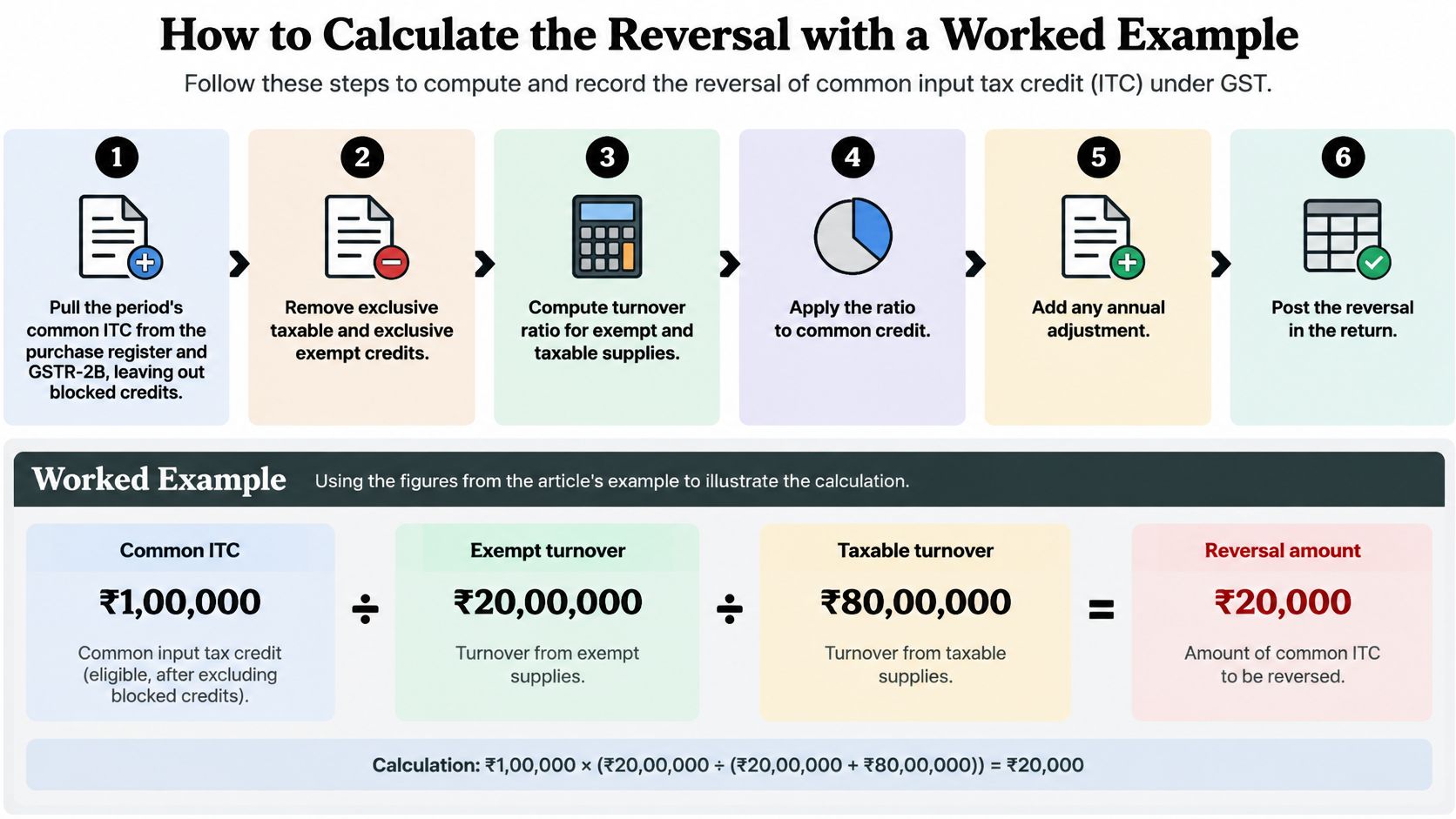
Use the same six steps every period, in the same order. Consistency matters because a reviewer, an auditor or you in six months should be able to trace the final figure back to named invoices without asking how you got there.
Six Steps in Order
- Pull the period's credit. Take ITC on inputs and input services from your purchase register and GSTR-2B. Leave out blocked credits under section 17(5) at this stage, because they were never available and don't belong in a Rule 42 proportion.
- Sort every invoice. Classify each line as exclusive taxable, exclusive exempt or common, then total the three buckets. Don't sort by supplier. One supplier can easily sell you goods for a taxable line, goods for an exempt line and a shared service in the same month.
- Compute E and T. Take exempt turnover and total turnover from the sales register for the same period, excluding GST on both. Divide E by T. The period must match the credit period, or the ratio describes a different business mix from the one that consumed the inputs.
- Apply the 5% test. If the ratio is at or below 5%, skip the common reversal for this period and record that result in the working. If it's above 5%, continue. Recording a nil outcome matters, because a blank working looks like a forgotten working.
- Calculate the reversal. Multiply common ITC by E/T to get the proportionate reversal, then add the exclusive exempt ITC in full. Those are two different reasons for reversal, so keep them as two lines even though they land in the same return row.
- Record the total for the return. Carry one clear total into GSTR-3B and keep the invoice-level working behind it. If the return figure can't be rebuilt from the working, it isn't finished.
Worked Example for One Period
Say a business makes taxable and exempt supplies in a month. Its common ITC is ₹1,80,000, exempt turnover is ₹4,00,000 and total turnover is ₹40,00,000, all turnover figures excluding GST. It also has ₹25,000 of credit on inputs used only for exempt supplies.
The ratio is ₹4,00,000 divided by ₹40,00,000, which is 10%. That's above 5%, so the common reversal applies. Multiply ₹1,80,000 by 10% and you get ₹18,000. Add the ₹25,000 exclusive exempt credit, reversed in full, and the total reversal is ₹43,000.
| Step | Figure | Result or note |
|---|---|---|
| Common ITC on inputs and services | ₹1,80,000 | Base for proportionate reversal |
| Exempt turnover (E) | ₹4,00,000 | Exempt supplies, excluding GST |
| Total turnover (T) | ₹40,00,000 | Taxable plus exempt, excluding GST |
| Ratio E/T | 10% | Above 5%, so the common reversal applies |
| Common credit reversal (D2) | ₹18,000 | ₹1,80,000 × 10% |
| Exclusive exempt credit (D1) | ₹25,000 | Reversed in full |
| Total ITC to reverse | ₹43,000 | Reported in GSTR-3B Table 4(B)(1) |
The most common slip is using turnover values that include GST. Taxable turnover then carries tax that exempt turnover doesn't, the ratio shifts, and every rupee after that point is wrong.
Check the result for sense before you file it. A 10% exempt share shouldn't produce a reversal larger than your common credit, and the exclusive exempt amount shouldn't change when the ratio changes. If either happens, a bucket total has been picked up twice.
You should end with three things. A reversal figure, a list of invoices in each bucket, and E and T workings that agree to the sales register. That set is what makes the number defensible, not the spreadsheet formula alone.
Year-End True-Up and Capital Goods Under Rule 43
A monthly ratio is provisional because your sales mix moves. One month with a large exempt order can push the ratio up, and the next month can pull it down, even though the same shared inputs served the business all year. The year-end adjustment corrects that distortion.
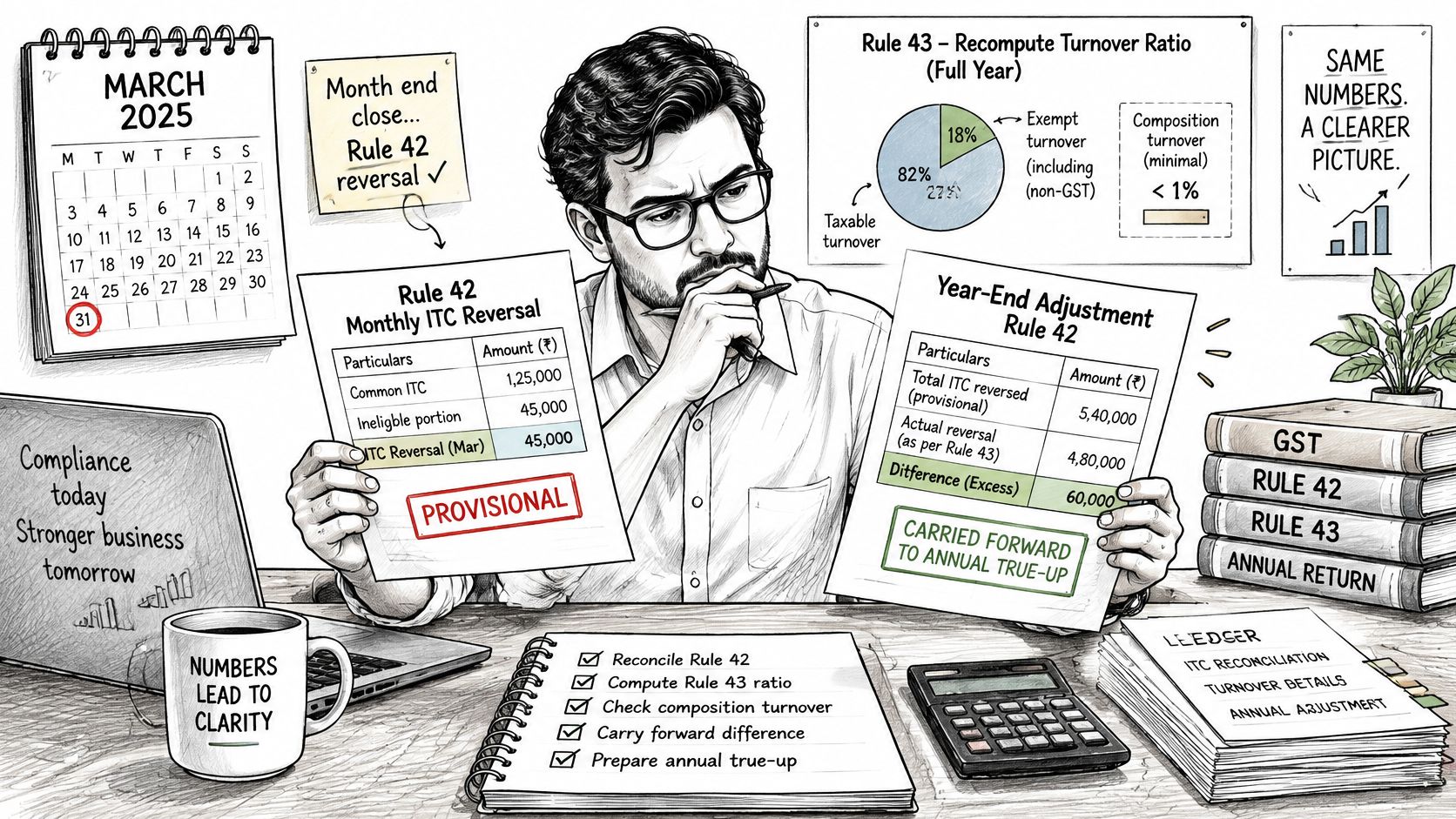
Recompute the ratio on full-year turnover and apply it to the year's common credit. Then compare that figure with the monthly reversals you've already made. The difference is usually reflected through the annual return in GSTR-9 rather than by reopening monthly returns.
Say your monthly reversals total ₹60,000, but the full-year calculation gives ₹72,000. You've under-reversed by ₹12,000, so you reverse that additional amount. If the full-year figure is lower than the monthly total, you've over-reversed, and you correct it the other way using the same comparison. Keep both totals visible so the adjustment reads as a reconciliation, not a fresh estimate.
Capital Goods Don't Behave Like Monthly Inputs
Capital goods sit under Rule 43, not Rule 42, because an asset serves you across many periods. Reversing its credit on one month's ratio would dump the whole effect into that month. Instead, the exempt share is worked out on a proportion and spread across the asset's useful life. You can check the mechanics in Rule 43 of the CGST Rules.
Take a ₹5,00,000 credit on a machine used for both taxable and exempt production, with a 10% exempt ratio. The exempt share of that credit is ₹50,000 in total, but it doesn't land in one month. It's recognised over the asset's life, and the amount in any period moves when the annual ratio or the remaining life in the schedule changes.
Keep a separate capital goods register. Record the asset, invoice date, credit taken, useful life, use pattern and reversal to date. Don't fold it into the monthly Rule 42 working, because the two schedules run on different timeframes and mixing them hides both.
Reporting Rule 42 Reversals in GSTR-3B and Your Books
Report first by provision, not by amount. Rule 42 and Rule 43 absolute reversals go in Table 4(B)(1), while section 16(2) and section 17(5) reversals go in Table 4(B)(2). If two reversals happen to be similar in size, that doesn't make them interchangeable, and netting them into one row destroys the reclaimability trail.
Check your filing date against the monthly GSTR-3B due dates before you post anything, so the reversal lands in the period you're filing and not the period you finished the working.
Posting the Reversal in the Books
A reversal means the credit is no longer available to set against output tax. Economically, that tax becomes part of your cost. So the entry reduces the input tax credit ledger and increases the relevant purchase or expense account.
For the ₹43,000 reversal in the worked example, the entry is straightforward.
- Debit purchases or the related expense: ₹43,000
- Credit input tax credit ledger: ₹43,000
Split the credit side by tax head so your ledgers agree with the return. For an intra-state supply where the original credit sat evenly in CGST and SGST, you'd credit ₹21,500 to CGST and ₹21,500 to SGST. For an inter-state supply, credit the full ₹43,000 to IGST. Follow the head in which the credit was originally taken, not the head that happens to have a balance.
Ledger check: If the ITC ledger movement for the month doesn't equal the Table 4(B) reversal total, one of the two records is incomplete. Find the gap before filing, not after a notice.
A section 16(2) reversal is posted the same way at first, debit purchases and credit the ITC ledger. The difference comes later. When you pay the supplier, you reclaim the credit and book that reclaim in the month of payment, reversing the earlier entry to the extent of the credit restored. Tagging that invoice correctly at the start is what tells your team a reclaim is due.
Book any year-end true-up in the period you record the adjustment, with a narration that names it as the annual Rule 42 adjustment and references the full-year working. A bare journal with no narration forces the next reader to guess whether it's a correction, a monthly reversal or an error.
Finish with a two-way match. The ITC ledger movement for the month should equal the reversal reported in Table 4(B), and the GSTR-3B figure should match the books for that same month. If the return is right but the books aren't, your cost is understated. If the books are right but the return isn't, your credit balance won't agree with the electronic credit ledger.
Confirm Your Rule 42 Reversal Before You File
Don't file until each reversal sits under the right provision and ties to the books. Run these five checks in order on the current month.
- Turnover basis: Confirm E and T exclude GST and that you've recorded the 5% test result for the period, including when the outcome is nil.
- Legal tagging: Tag every reversed invoice to Rule 42, Rule 43, section 16(2) or section 17(5) using the three-question check.
- GSTR-2B match: Match reversed invoices against GSTR-2B by supplier GSTIN, invoice number and tax amount. Flag anything in the books but missing from GSTR-2B, or the reverse. Charter offers unlimited GSTR-2A/2B reconciliation that matches returns against the books and works through only the entries that need attention.
- Year-end position: Confirm the annual adjustment is booked, or clearly deferred to the annual return as planned.
- Return to books tie-out: Confirm Table 4(B)(1) and 4(B)(2) together equal the reversal total in the books. Our matching runs on fixed rules, not AI arithmetic, with GST 2A/2B matching and other checks showing their source and date last reviewed.
Three mistakes cause most queries. A reversal posted to the wrong table, capital goods missing from the Rule 43 schedule, and an invoice tagged to Rule 42 that belongs under section 16(2). Complete this sign-off before the GSTR-3B deadline and keep it on file as your audit trail.
Run your Rule 42 sign-off against reconciled data instead of rebuilding matches in spreadsheets each month. Charter AI gives CA firms rules-based GSTR-2A/2B reconciliation against the books, source-linked GST research and bookkeeping that exports to TallyPrime, so every reversal can be traced to its invoice. Visit Charter AI to organise your next filing cycle around workings your team can defend.