
GST on Sale of Land: Taxable or Exempt in 2026
Wondering about GST on sale of land in India? Learn when land, buildings and development services are taxed, plus valuation, ITC and compliance steps.
Published 18 min read
No GST is charged on an outright sale of land in India, and there is no GST rate to apply to the land price itself. But a separately billed development service on the same plot, such as levelling or laying a drainage line, can still attract GST at the rate for that service.
That single sentence splits most land deals into two distinct tax worlds. The invoice label on a real estate transaction doesn't decide the outcome. What matters is the legal subject matter, the timing of payments, and whether any work is billed apart from the land consideration. A developer can sell a plot for ₹80 lakh and charge ₹6 lakh for development work, and the GST treatment of those two amounts will differ completely. That's the analytical core of GST on sale of land in India, and it's where most compliance mistakes begin.
Table of Contents
- When GST Applies to a Land Deal
- Why Land Sits Outside the GST Net
- Where the Tax Line Falls Between Land and Buildings
- Developed Land and Separately Billed Development Work
- Valuation and Input Tax Credit on Mixed Projects
- Valuation Rules and Stamp Duty
- Development Rights, Legacy Agreements and Open Disputes
- Confirm the Treatment Before You Sign or File
When GST Applies to a Land Deal
An outright sale of land is treated as neither a supply of goods nor a supply of services under paragraph 5 of Schedule III to the Central Goods and Services Tax Act, 2017. That means no Central GST or State GST applies to the consideration for the land itself. The position is not a zero-rated supply or an exemption. The transaction sits outside the definition of supply altogether.
But a land deal often contains more than land. It can include development work, a building, brokerage, or a transfer of development rights. Each component gets its own GST treatment, and the table below shows how the common types break down.
| Transaction | GST position | Basis |
|---|---|---|
| Outright sale of vacant land | No GST on the land price | Schedule III, paragraph 5 |
| Sale of land after levelling, drainage, water or electricity lines | No GST on the land price | Circular 177/09/2022 |
| Development work billed separately (levelling, drainage, lines) | Taxable at the rate for that service | Circular 177/09/2022 |
| Sale of a completed building, full consideration received after completion certificate or first occupation | Excluded from GST | Schedule III, paragraph 5 |
| Sale of a building before completion or first occupation | Taxable as construction service | Rate per current notification |
| Transfer of development rights under a joint development agreement | Depends on transfer date and consideration; partly disputed | Section 9 read with rules on reverse charge |
The critical point is that one land deal can contain both exempt and taxable components. The land price is outside GST, but a separately identifiable development service can create GST liability. Indian practitioners who read the whole consideration as a single taxable or non-taxable amount will misclassify part of the deal.
Practical rule: Don't read an agreement by its cover page. Read it by its components. The phrase "land sale" tells you nothing about the development charges, brokerage fees, or construction services bundled inside.
To place any specific deal, apply three questions. First, what is being transferred: land, a building, or a development right? Second, when do the building milestones fall, specifically the completion certificate and first occupation dates relative to payment dates? Third, whether any work is charged apart from the land price, and if so, how it's invoiced. If the answer to the third question is yes, a tax amount follows even when the land itself stays outside GST. For more on the core statutory framework, refer to the CGST Act, 2017 provisions that define the scope of supply.
Why Land Sits Outside the GST Net
GST is a tax on goods and services as they move along the supply chain, like a toll charged at each stage of a road. Land is not a vehicle travelling on that road. It's the road surface itself, the fixed foundation on which every other transaction happens. The law reflects this distinction by keeping immovable property outside the tax base.
Section 7 of the Central Goods and Services Tax Act, 2017 gives legal effect to Schedule III, whose paragraph 5 states that sale of land is treated as neither a supply of goods nor a supply of services, as the Central Board of Indirect Taxes and Customs' CGST Bill document sets out. A direct transfer of land therefore does not attract Central GST or State GST, and there is no GST rate or percentage to apply to the land-sale consideration itself. This statutory treatment has applied since the GST regime commenced on 1 July 2017.
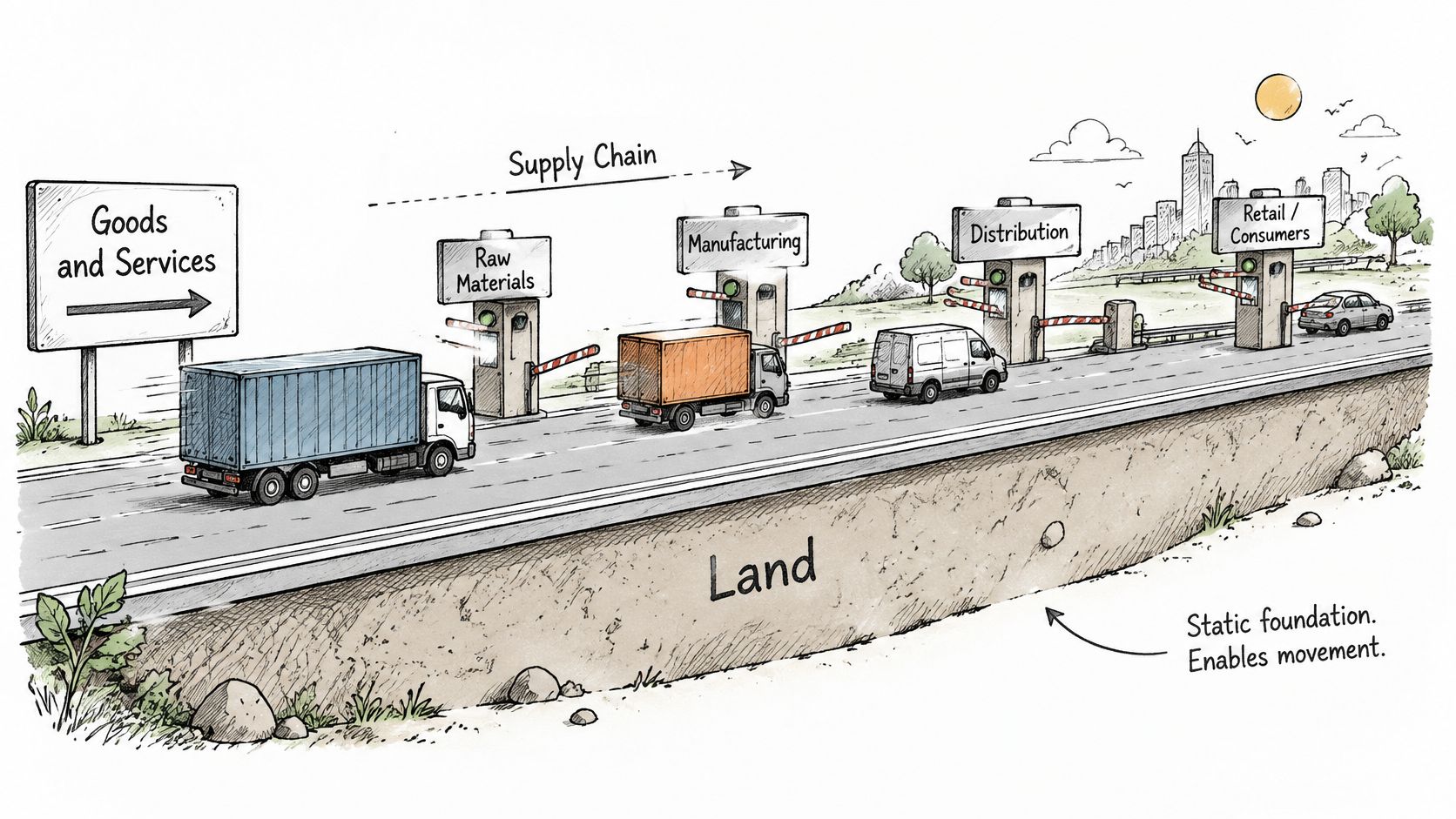
The same paragraph draws a second line that shapes Indian real estate tax analysis. It excludes the sale of a building when the entire consideration is received after the completion certificate is issued or after first occupation. That timing caveat matters. A transaction described commercially as a real-estate sale must be classified by its legal subject matter and timing, not merely by the invoice label. Two buyers can sign sale deeds for identical shops on the same day, and one deal will be outside GST while the other attracts tax, purely because of when payments landed.
The classification rule follows directly from the statutory structure. A sale of land is not a supply of goods or services, so no output tax liability arises on the transfer price. But the same Act treats the land-sale component as an exempt-supply item for specific input tax credit calculations, even though it is technically outside the definition of supply. Removing the transfer from the tax base doesn't automatically remove every tax consequence tied to the deal, a point that becomes sharper when input tax credit and valuation rules come into play.
Where the Tax Line Falls Between Land and Buildings
Buildings have their own classification path under Schedule III. A sale of a building is excluded from GST only when the entire consideration is received after the completion certificate is issued or after first occupation, whichever rule applies in the specific deal. That phrase, "entire consideration", is the hinge. A single rupee received before the relevant milestone can move the whole transaction outside the exclusion.
The test runs in four steps:
- Find the completion certificate date. Pull the actual document from the competent authority, not a letter of intent or an occupancy note. If no certificate is required under local law, establish that fact and note the first occupation date instead.
- Find the first occupation date. This is usually earlier than the certificate date, and earlier means more restrictive for the taxpayer. If the buyer has occupied the building, the first occupation date controls.
- List every payment date. Include booking amounts, advance payments, instalments, and the final balance. Ignore the sale deed date for now. It does not determine the tax treatment; the payment schedule does.
- Compare the payment schedule to the relevant milestone. If any consideration lands before the completion certificate or first occupation date, the building sale can fall outside the Schedule III exclusion.
A commercial shop example makes the split concrete. Say a buyer pays a ₹10 lakh booking amount in March for a shop under construction. The completion certificate arrives in August, and the buyer pays the balance of ₹60 lakh in September. The sale deed is executed in October. Because ₹10 lakh was received before the certificate, the construction component of the deal may be taxable. The buyer's later payment schedule doesn't cure the earlier booking amount.
Rule of thumb: A payment schedule often matters more than the sale deed date, especially for commercial buildings. Buyers and sellers who focus on the deed date alone miss the tax trigger that already happened months earlier.
Commercial shops and offices are the frequent point of confusion because parties tend to treat them like completed assets once interiors are ready. The statutory test doesn't care about interior readiness. It cares about the completion certificate or first occupation date. To test any deal against the rule, pull three records: the certificate date, the occupation date if relevant, and a full payment ledger showing every inflow with its date. Without all three, the four-step test cannot be run reliably.
Developed Land and Separately Billed Development Work
On 17 September 2022, the Central Board of Indirect Taxes and Customs issued Circular No. 177/09/2022-TRU, which settled one of the most recurring questions in plotted development. Land sold after activities such as levelling or the installation of drainage lines, water lines, or electricity lines remains a "sale of land" covered by paragraph 5 of Schedule III, as CBIC's circular confirms. The mere presence of basic development work doesn't convert the whole transaction into a taxable supply.
The circular, however, draws a numerical and legal boundary at the same time. Services supplied for development of land, such as levelling or laying drainage lines, are independently taxable at the applicable rate for those services. So while the consideration attributable to the land itself stays outside GST, a separately identifiable development service can create a GST liability. Plotted developments and real estate arrangements frequently combine land consideration with infrastructure or development charges, which is exactly where the boundary becomes operationally important.
The table below classifies the charges that commonly appear in plot agreements.
| Item | GST treatment | Invoicing |
|---|---|---|
| Land price | Land consideration, outside GST | Separate line stating the land value |
| Levelling and earthworks charge | Development service, taxable at the rate for that service | Separate invoice with a stated reason |
| Drainage, water and electricity line charges | Development service, taxable at the rate for that service | Separate invoice with a stated reason |
| Road or boundary wall work | Service, taxable at the rate for that service | Separate invoice with the scope stated |
| Brokerage | Service, taxable | Separate invoice from the broker |
| Infrastructure or development charges | Land consideration if no separate service is identifiable, taxable if a service is supplied separately | Separate line with a stated reason |
A worked example shows where the tax lands. Say a plot is priced at ₹80 lakh, and the seller separately invoices ₹6 lakh for levelling and drainage work. GST applies only to the ₹6 lakh development charge, at the rate for that service under the current notification. The ₹80 lakh land price stays outside GST. One agreement with a single undivided price of ₹86 lakh would leave both the seller and the buyer guessing which part of the ₹86 lakh is taxable, and revenue authorities may treat a larger portion as service consideration during an audit.
Separate the components in writing. Write each line item with a stated reason for its classification. That gives you the documentation to defend the split later, and it prevents a basic land deal from turning into a taxable development service claim by default.
Valuation and Input Tax Credit on Mixed Projects
An outright sale of land is treated as neither a supply of goods nor a supply of services, not as a taxable supply subject to a zero rate. No GST is chargeable on the land-sale consideration, and the transaction should not be reported as an ordinary taxable outward supply, as the updated CGST Act text shows. That's the headline. The quiet part is that the transaction still produces GST compliance consequences through input tax credit attribution and valuation rules.
Developers who sell land and taxable construction work from the same project cannot treat every input tax credit as available. Section 17(3) treats the sale of land as an exempt-supply component when determining input tax credit attribution. That means a developer must segregate land consideration from taxable construction, development, brokerage, and infrastructure services in agreements, invoices, accounting records, and ITC workings. When these elements are mixed, disputes arise over whether input tax relates to non-taxable land sale or taxable services.
| Component | ITC or valuation treatment | Basis |
|---|---|---|
| Land price on outright sale | Exempt-supply component for ITC attribution; no GST charged | Section 17(3) read with Schedule III |
| Taxable construction or development service | Input tax credit attributable to the taxable supply | Standard ITC rules under the CGST Act |
| Shared inputs used for both land and taxable work | Apportion and document the split on a stated basis | ITC workings and invoice records |
| Land value for valuation purposes | Stamp-duty value may be used | Rule 44 and related valuation provisions |
The apportionment example makes the point concrete. Say a developer builds ten flats and sells the land with them. A shared cement invoice of ₹5 lakh serves both the land-linked component and the taxable construction component. The developer must apportion that ₹5 lakh input tax credit between the exempt land portion and the taxable construction portion using a documented basis, such as carpet area sold before and after completion or a similar reasonable allocation method. If the developer cannot show, with records, which part of the input tax relates to a taxable service, the credit claim on the entire invoice is at risk.
Valuation Rules and Stamp Duty
Valuation adds a second layer. Rule 44 and related valuation provisions can require the value of land to be considered using the stamp-duty value, which is a state levy entirely separate from GST. A developer should not treat the stamp-duty value as a GST base. The stamp-duty value influences apportionment for input tax credit purposes, not the GST payable on the land itself. When a developer sells land through a mixed project, two separate concepts sit side by side: the land price is removed from the GST base, and the stamp-duty value is used for prescribed ITC apportionment calculations.
The records to keep are specific: the agreement, the invoices showing each taxable service, the accounting ledger separating land and service consideration, and a written ITC apportionment schedule showing the basis used. Failure to keep any one of these creates a documentation gap that becomes expensive later. For the full rules context, see the CGST Rules, 2017 provisions on valuation and input tax credit.
Development Rights, Legacy Agreements and Open Disputes
Development rights sit in a different legal bucket from land. A transfer of land is outside GST, but a transfer of development rights can create a taxable supply under the reverse charge mechanism. The complication is that the treatment is partly settled and partly contested, and the transfer date changes which rule applies.
The CBIC real estate FAQ material distinguishes transactions based on when development rights were transferred. A transfer before 1 April 2019 does not attract the post-2019 reverse-charge rule merely because consideration is received afterwards. That date is a sharp cutoff. A joint development agreement signed in March 2019, with payments flowing in 2026, falls outside the later reverse-charge rule for the transfer itself. The same material addresses consideration received as TDR or FSI, indicating that non-cash consideration is not automatically "free" and may itself represent a taxable supply. Getting FSI in exchange for development rights can trigger a tax liability on the FSI's value, even when no cash changes hands.
The Telangana AAR supports reverse-charge liability for a promoter receiving development rights. But expert commentary reports continuing judicial uncertainty and proceedings concerning the legal basis for taxing such rights in the first place. The point isn't that one answer is certain and the other is wrong. It's that two defensible positions exist side by side, and practitioners need a framework, not a final verdict.
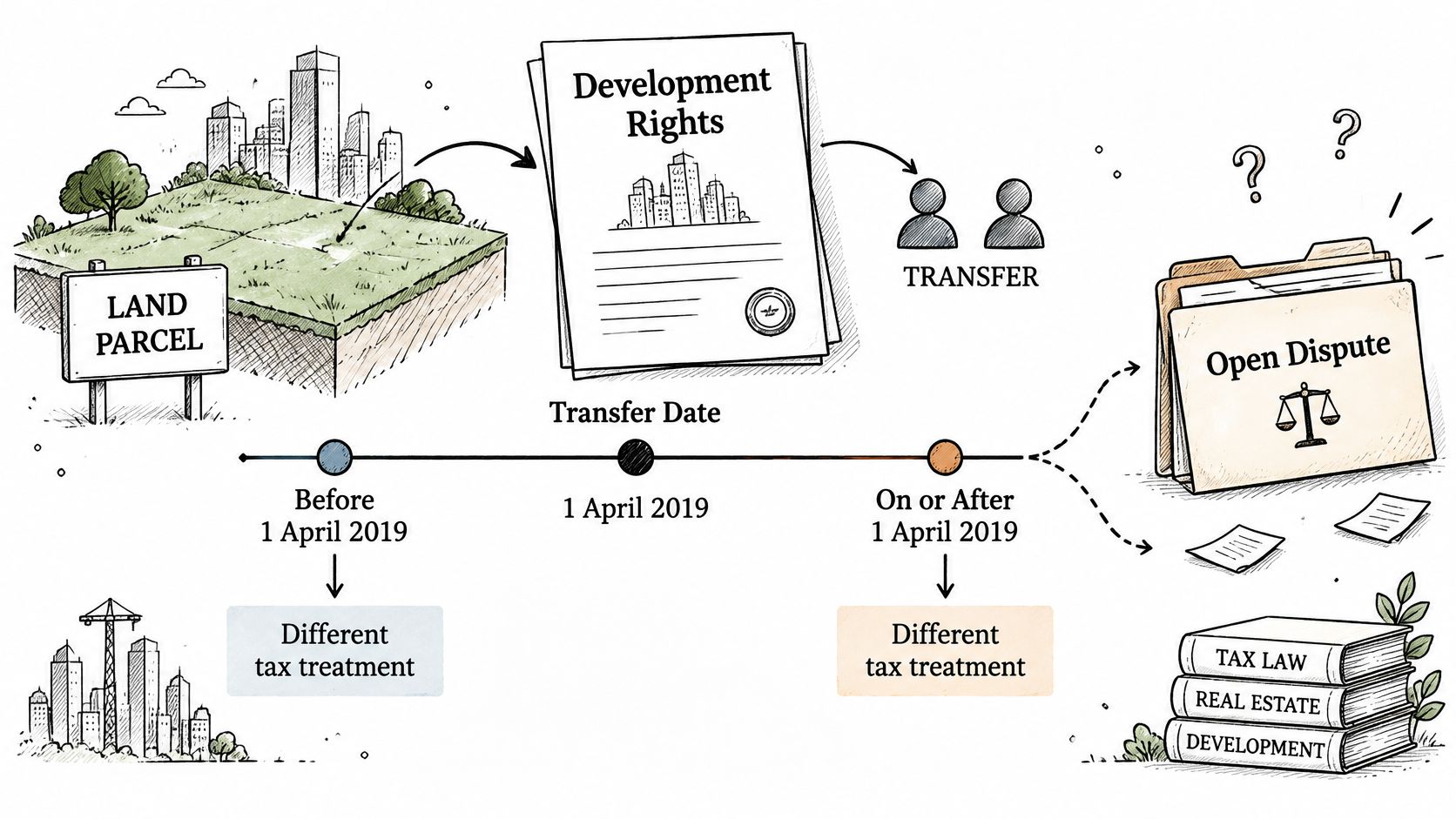
The decision sequence for a legacy joint development agreement runs in five steps:
- Pin the transfer date from the agreement. The operative date in the document, not the possession date or the payment date, controls whether the pre- or post-1 April 2019 rule applies.
- Map cash and in-kind consideration separately. Cash instalments, TDR, FSI, and any other non-cash benefits each need their own classification and, where applicable, their own valuation.
- Track phased development, deferred possession, and cancellation clauses. A phased project can create multiple transfer events, each with a different date and tax treatment. A cancellation may unwind a taxable supply or create a fresh one.
- Record reverse-charge payments and ITC entries. Where reverse charge applies, the payment and the corresponding input tax credit must both be documented at the time of the event, not when the dispute eventually resolves.
- Decide whether a disclosure or a protective claim is appropriate. While the legal basis for taxing development rights remains contested, a written disclosure or a protective claim preserves the taxpayer's position without conceding the substantive issue.
Position-keeping rule: Preserve alternative positions in writing for every legacy JDA. Document the transfer date, the consideration map, and the reason for the chosen treatment. If the matter goes before an authority, that documentation is what separates a recoverable position from an abandoned one.
Legacy JDAs in phased development are the highest-risk cases because multiple transfer dates, mixed consideration, and unresolved legal questions combine in a single contract. Any Indian CA firm handling such an agreement should obtain specific written advice before relying on a single treatment.
Confirm the Treatment Before You Sign or File
A land deal's GST treatment is usually decided before the sale deed is signed, not after. The documents that determine the answer, the completion certificate date, the payment schedule, and the invoice split, all exist at the time of signing. Checking them beforehand avoids reclassification and credit disputes later.
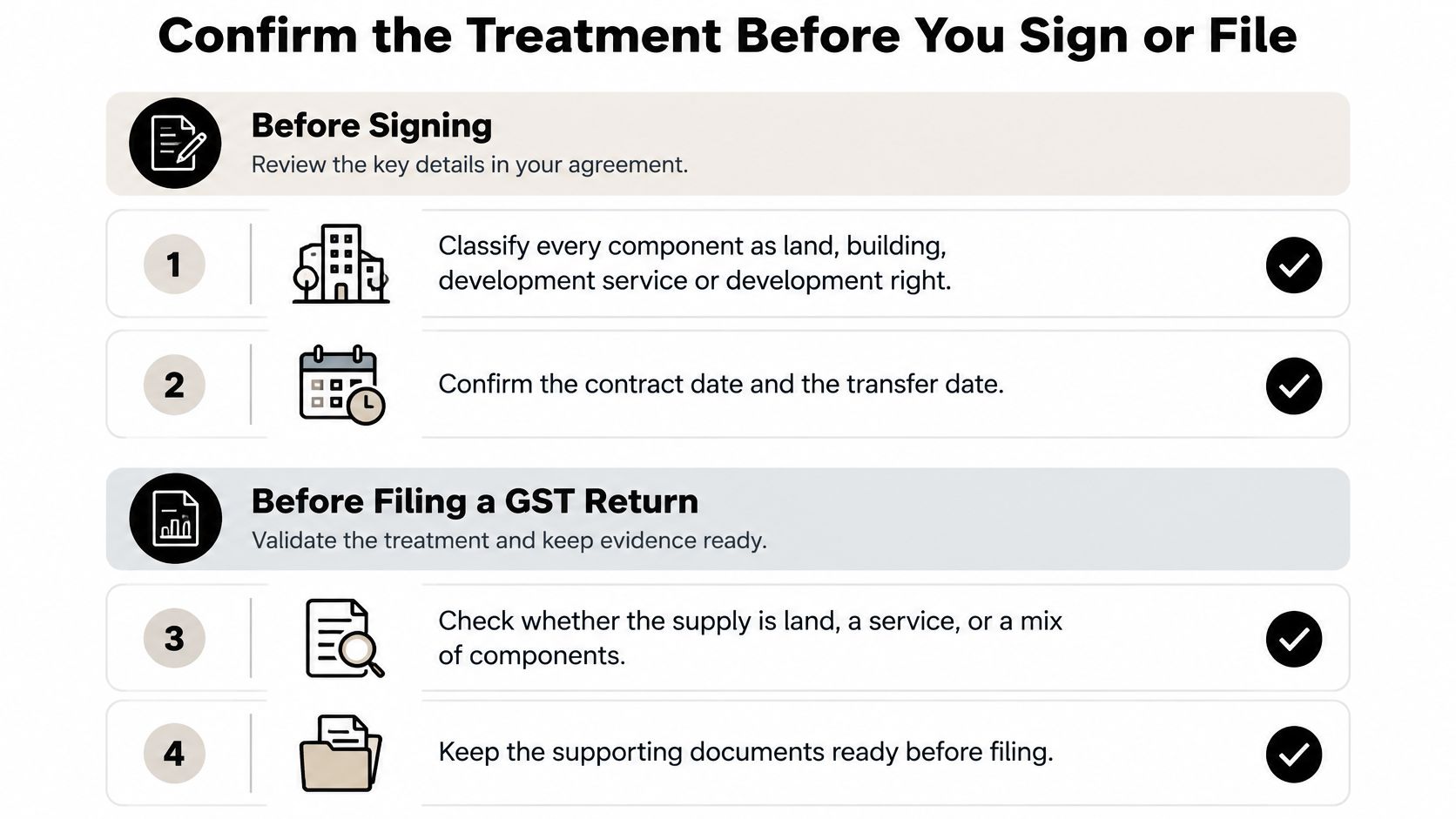
Run these seven checks before signing and again before any GST return is filed:
- Classify every component as land, building, development service, or development right. Don't leave any charge unclassified.
- Confirm the completion certificate and first occupation dates for any building component selected. Pull the actual documents, not an email confirmation.
- Compare the payment schedule against those dates, including booking amounts and instalments. A pre-milestone payment changes the answer.
- Check that development services are invoiced separately with a stated reason for each line item. One undivided price invites disputes.
- Document the apportionment of shared input tax credit on a stated basis, such as area or turnover, and keep the workings.
- Log the transfer date for any legacy joint development agreement, including the day each development right moved.
- Check the current rate notifications before filing. Rates for construction services change by notification, not by memory.
Keep the agreement, the completion certificate, the occupation record, the full payment ledger, the invoices, and the input tax credit workings together in one file. When a notice under scrutiny of GST returns under section 73 arrives, that file is what you'll need to answer the notice without reconstructing a position from memory. The decision rule is simple: sign only after all seven checks are complete, and treat any unresolved item, especially a legacy joint development agreement or a split payment schedule, as a reason to obtain written advice before the agreement is executed.
When a land deal crosses the line into a mixed transaction, go back to the component classification and the payment schedule. The earlier you identify the taxable service, the cleaner the return filing becomes. Charter AI helps Indian CA firms run GSTR-2A and 2B reconciliation that matches returns against the books and surfaces only the entries that need attention, so a mixed land and service invoice doesn't sit unnoticed in the purchase register until a notice arrives. If you're handling multiple such deals across clients, visit Charter AI to see how the workspace handles reconciliation, source-linked research, and notice drafting in one place.