
GST Legal Services in India: Rates, Supply and ITC Rules
Learn how GST legal services are taxed in India: who pays 18% under reverse charge, place of supply, valuation and input tax credit rules.
Published 17 min read
The legal bill is ready, but the accounts team has stopped it. The engagement names the parent company, the work concerns a subsidiary, and the expense sheet combines counsel fees, travel and court payments. The client wants an invoice without GST, while the billing partner wants to know whether that leaves the firm exposed.
The tax decision belongs before the invoice, not after the payment dispute. For GST legal services work, the supplier's professional status, the actual recipient, their locations and the treatment of reimbursements can change the result. A familiar client name or a standard invoice template isn't enough.
Table of Contents
- Who Pays GST on Legal Fees and at What Rate
- Separate the supplier from the service description
- Where Legal Services Are Taxed by Place of Supply
- Missing information isn't a fallback rule
- Which Exemptions Actually Apply
- Test the recipient as carefully as the work
- Valuing Fees, Retainers and Reimbursed Expenses
- Distinguish disbursements from the firm's own costs
- Build the bill from evidence
- How to Invoice and Pay GST on Reverse Charge Work
- Keep the CA practice's service lines distinct
- Claiming Input Tax Credit on Legal Fees
- Check business use and eligibility separately
- Use reconciliation without making it the legal test
- Responding to a GST Scrutiny Notice
- Identify the procedural stage
- Preserve the timeline
- Re-check the Tax Decision at Every Invoice
- Make the review part of the workflow
Who Pays GST on Legal Fees and at What Rate
Two fee notes can carry the same amount and still need different GST treatment. A litigation bill to a registered company, a personal matter for an individual and an overseas advisory invoice may sit in one billing run, but the payer and rate are decided client by client.
| Client and supplier | Who pays GST | Rate | Mechanism |
|---|---|---|---|
| Advocate or firm to a business entity in India | Recipient where the notified reverse-charge category applies | 18% for legal services under SAC 9982, only after the exemption check fails | Reverse charge; client reports and pays |
| Advocate to an individual client in India | No payer where the applicable legal-services exemption covers the recipient | Nil while the exemption applies; use 18% under SAC 9982 only if the matter falls outside it | Do not assume forward charge merely because the recipient is an individual |
| Unregistered advocate to a registered business | Recipient where the notified reverse-charge category applies | 18% under SAC 9982 where the supply is taxable after the exemption check | Supplier's lack of registration does not by itself remove the recipient's liability |
| Advocate to a client outside India | No output tax payable where qualifying export treatment is used | 0% under zero-rated export treatment, subject to export conditions | Verify the recipient, place of supply and other export requirements |
Do not start with a blanket rate or a blanket forward-charge rule. Treating every advocate's bill to an individual as a taxable forward-charge supply can produce the wrong invoice. I would test four facts before release: supplier capacity, recipient category, recipient location and whether reimbursements are billed as part of the fee.
The rate decision has two gates. First ask who must pay, forward charge by the firm or reverse charge by the recipient. Then ask what rate applies after exemptions and export conditions are excluded.
The GST Council describes recommendations covering exemptions, place-of-supply rules, registration thresholds and rate bands. A Council recommendation is not the operative instrument, so the billing file should point to the notification that gives the treatment legal effect.
Separate the supplier from the service description
An advocate's legal-services invoice and a CA firm's tax-advisory invoice should not automatically receive identical treatment. Identify who legally supplies the work, the professional capacity in which they act and what the engagement covers.
For a CA practice coordinating litigation, distinguish its own advisory fee from an independent advocate's fee. Calling both lines legal expenses in the client's ledger does not settle their GST treatment.
Billing rule: An invoice without GST can still create a tax-payment obligation for the recipient. Absence of tax on the bill is not evidence of exemption.
Before releasing the bill, answer these questions:
- Recipient category: Is the recipient acting as a business or receiving a personal service?
- Recipient location: Which establishment receives the service?
- Applicable treatment: Does an exemption, notified reverse charge or qualifying export treatment apply?
Record the rate from the operative notification in the decision note. An unsupported rate copied from an old billing template should not become the firm's tax position.
Where Legal Services Are Taxed by Place of Supply
Determine the place of supply before selecting the tax head. For a registered business recipient under the general domestic rule, the recipient's location is central to the analysis, but first check whether a specific rule displaces that general treatment.
Use the location review as a billing control, not merely an address check.

| Scenario | Tax applied | Example |
|---|---|---|
| Firm and client in the same state | CGST and SGST where the supply is taxable and intra-state | Delhi firm, Delhi company |
| Firm and client in different states | IGST where the supply is taxable and inter-state | Pune firm, Gurugram company |
| Client outside India, export conditions met | Zero-rated export treatment | Mumbai firm, Singapore company |
| Client location missing from records | Establish the applicable recipient-status rule before using a fallback | Firm obtains the address and registration details before billing |
Missing information isn't a fallback rule
A missing engagement-letter address doesn't automatically justify using the supplier's location. For a registered recipient, obtain the relevant registration and identify the establishment receiving the service; don't replace that enquiry with the address easiest to find.
A foreign billing address also doesn't establish an export by itself. Review the recipient, contractual arrangement, place of supply and other export conditions under the IGST Act.
Say a Pune practice advises a company with establishments in Maharashtra and Haryana. The engagement, instructions and deliverables should identify which establishment receives the work, rather than allowing the payment team to choose a GSTIN after completion.
The accompanying video provides additional context for the billing review.
Keep the location conclusion beside the engagement acceptance. That gives the billing team a documented basis for selecting the tax head without asking them to reconstruct the commercial arrangement.
Which Exemptions Actually Apply
The myth to reject is that court work is automatically exempt. The opposite shortcut, that every legal fee to an individual is taxable, is equally unsafe.
An exemption requires a match between the service, supplier, recipient and conditions in the applicable entry. The description on the invoice doesn't create that match, and a client's request for a bill without GST doesn't establish eligibility.
Test the recipient as carefully as the work
A private company asking an advocate to conduct litigation hasn't established exemption merely by describing the assignment as a court matter. Equally, a personal client shouldn't be pushed into forward charge without checking whether the legal-services exemption covers that recipient.
Build the exemption note around the actual conditions:
- Service and supplier: Identify the legal service and the capacity in which the supplier provides it.
- Recipient category: Record whether the recipient falls within the category specified by the entry.
- Conditions and evidence: Attach the declaration, status records or other documents needed to support the conclusion.
- Current authority: Retain the operative notification text and relevant amendments, not an undated summary.
Don't confuse exemption with reverse charge. One removes tax under an applicable entry; the other changes who pays it.
A broad invoice description such as professional charges makes later review harder. Use a description that identifies the assignment without disclosing privileged advice, and retain the detailed scope in the matter file.
If the exemption analysis remains unresolved, hold the bill for review. Issuing first and researching later transfers a legal uncertainty into receivables, client correspondence and potentially corrective documentation.
Valuing Fees, Retainers and Reimbursed Expenses
| Fee component | Included in taxable value | Treatment |
|---|---|---|
| Professional fee, monthly or fixed | Ordinarily yes | Identify the consideration for the service separately from disbursements |
| Retainer | Yes where it constitutes consideration | Review its contractual character and applicable time-of-supply treatment |
| Success or contingency fee | Where it constitutes consideration for a legally permissible arrangement | Check professional permissibility and the applicable tax point |
| Court or filing fees paid as pure agent | Excluded only where the pure-agent conditions are satisfied | Show actual cost separately and retain receipts and authorisation |
| Travel, copying and courier billed to client | Ordinarily included unless a valid exclusion applies | Separate presentation alone doesn't establish pure-agent treatment |
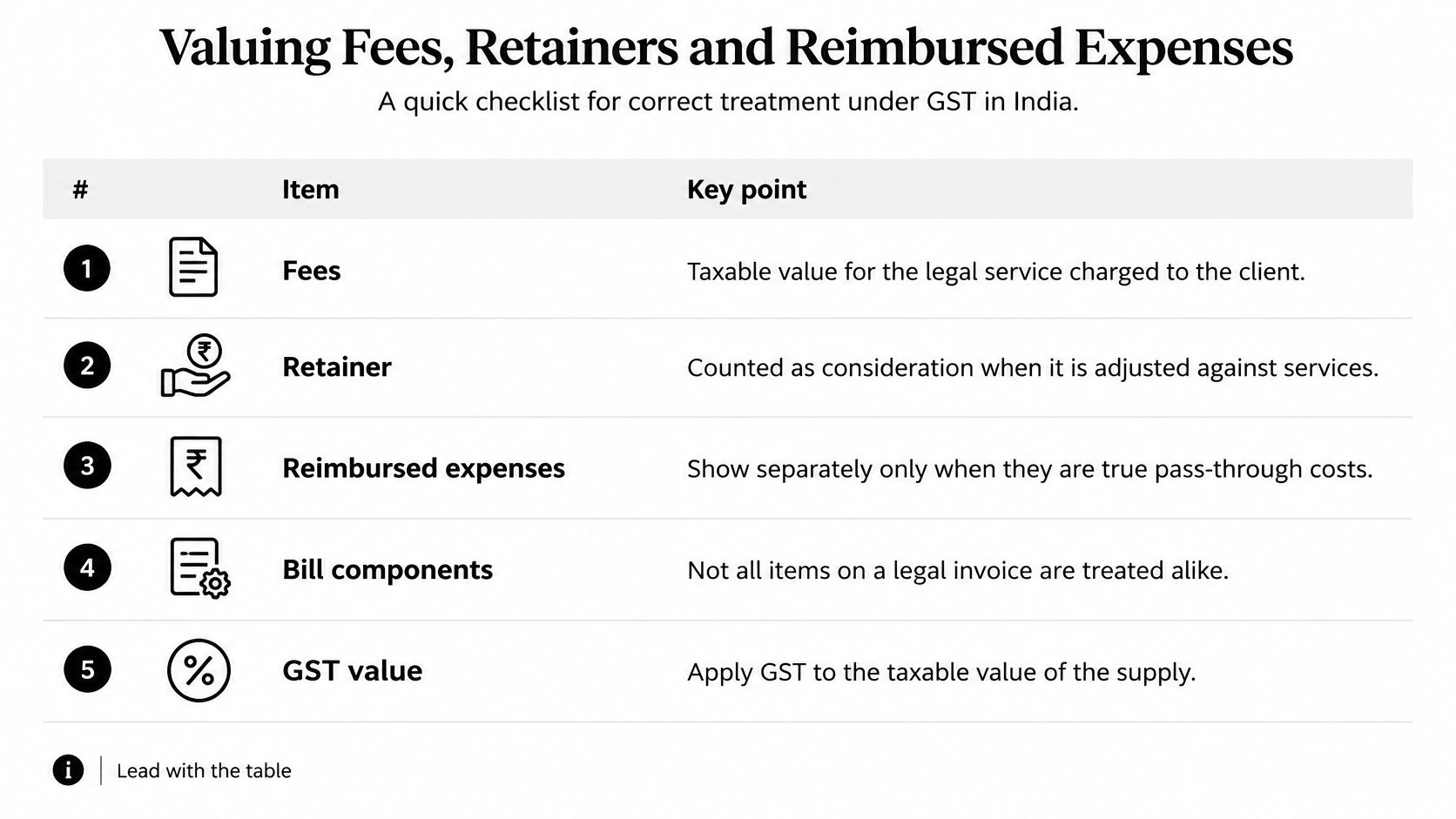
The taxable-value review starts with what each amount represents, not the heading the accounts team gives it. A reimbursement can remain part of the consideration for the firm's service even when the firm recovers exactly what it spent.
A separate line is useful evidence. It isn't, by itself, a statutory exclusion.
Distinguish disbursements from the firm's own costs
For a proposed pure-agent exclusion, inspect the underlying obligation and authority. Establish who owes the third party, whether the client authorised payment, whether the firm uses the purchased service for its own account, and whether recovery is restricted to the actual amount.
Court payments made on the client's behalf may support a different analysis from the firm's travel to attend a hearing. The travel enables the firm to perform its assignment; labelling it out-of-pocket expense doesn't settle its valuation.
The following checklist is useful for organising the documents, but the legal classification still needs review.
Build the bill from evidence
Say an advocate's bill contains a fixed professional fee, a court payment and courier charges. Start with the fee as consideration, test the court payment against the pure-agent conditions, then examine the courier charge independently instead of treating every expense alike.
The supporting schedule should show:
- Professional fee: Scope reference, billing milestone and amount payable.
- Client disbursement: Authorisation, third-party receipt and basis for any exclusion.
- Recoverable practice expense: Receipt and the reason it forms part of the billed service.
- Adjustment: Credit, earlier advance or retainer allocation, with a clear cross-reference.
An inclusive quote creates a separate commercial problem. If the contract fixes the client's total payment, tax may have to be extracted from that amount rather than added to it, reducing the supplier's fee realisation.
Don't automatically equate retainer billing with the tax point. Review whether the receipt is an advance for services, a refundable deposit or another arrangement, then apply the relevant timing rules.
Finally, don't imply that success-based billing is professionally permissible merely because its GST treatment can be analysed. Professional-conduct requirements need their own review.
How to Invoice and Pay GST on Reverse Charge Work
The invoice note, accounting entry and payment process must express the same treatment. A reverse-charge label won't repair a bill whose total also collects tax from the client.
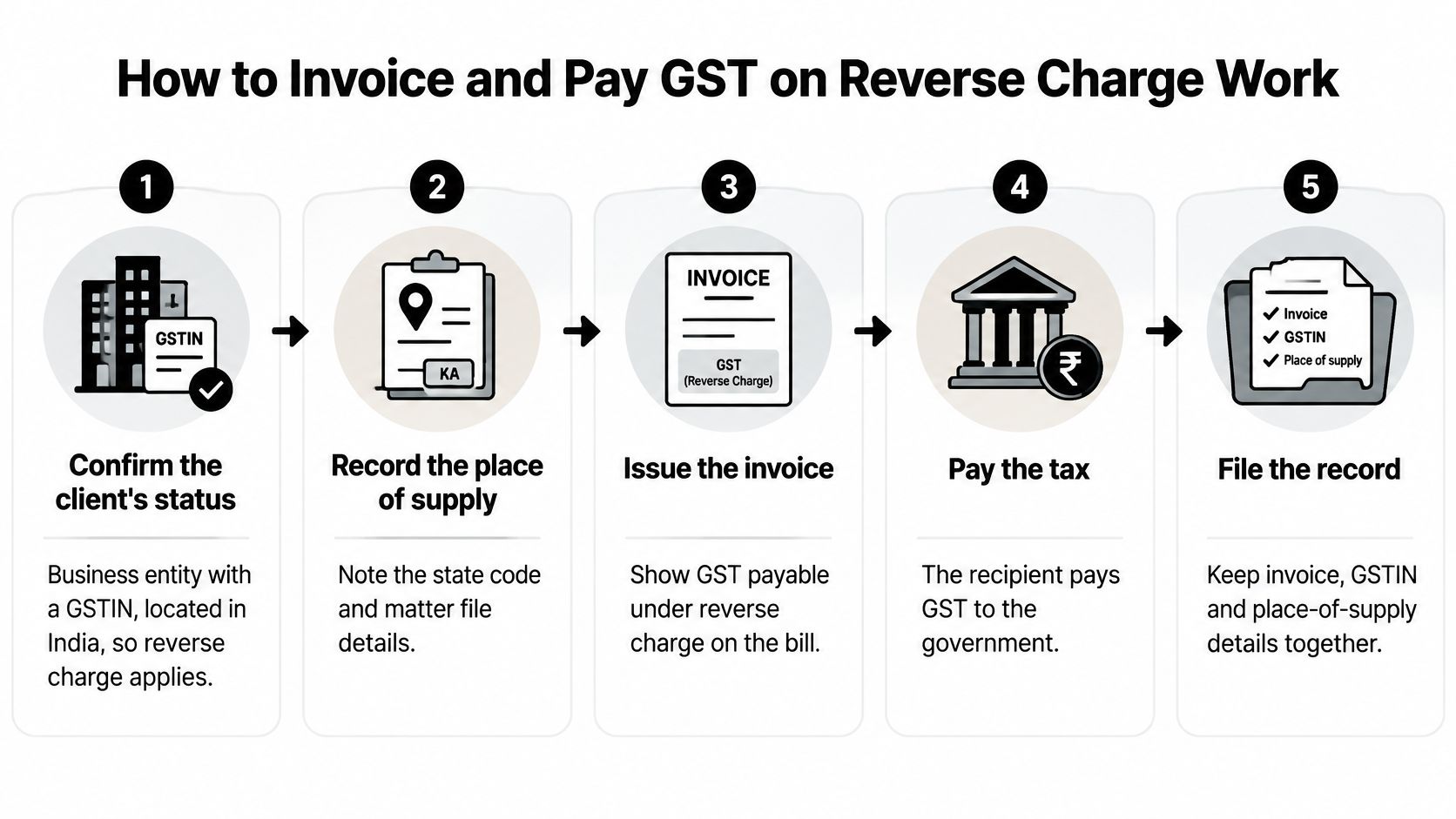
Confirm the actual supplier and recipient. Establish that the supplier and service fall within the notified category, then check the recipient's business status and any exemption. A GSTIN is useful identification, but it isn't a complete reverse-charge test.
Record the location decision. Put the relevant establishments, state details and place-of-supply conclusion on the matter file. This prevents the billing team from selecting the tax head solely from the address used for correspondence.
Issue a consistent invoice. Where reverse charge applies, state that the recipient is liable and keep the professional fee and reimbursed items separately identifiable. Avoid collecting GST merely because the invoice software adds it by default, as this creates a recovery and correction problem without resolving the recipient's obligation.
Check recipient-side documentation. The client should record the inward supply and determine whether self-invoicing, payment documentation or other prescribed records are required. Don't generate a duplicate supplier invoice without checking why the rule requires it.
Arrange the cash payment and reporting. The recipient's team should distinguish the tax liability from any later credit claim and use the prescribed payment route. Allocate responsibility for the return entry before the invoice reaches the payment queue.
Close the evidence trail. Retain the invoice, tax computation, payment reference and filed-return acknowledgement together. Reconcile the taxable base, calculated liability, cash-ledger debit and return disclosure, rather than expecting unlike amounts to be identical.
Use the process graphic as a hand-off aid between billing and accounts.
Keep the CA practice's service lines distinct
A CA firm shouldn't apply an advocate's reverse-charge treatment to its own fees just because its team handles a tax dispute. Maintain separate ledger classifications for the practice's advisory work, advocate invoices and client disbursements.
The extra classification takes effort at engagement setup. It saves the accounts team from making a legal-status decision at every payment run and makes client queries easier to answer from the records.
Claiming Input Tax Credit on Legal Fees
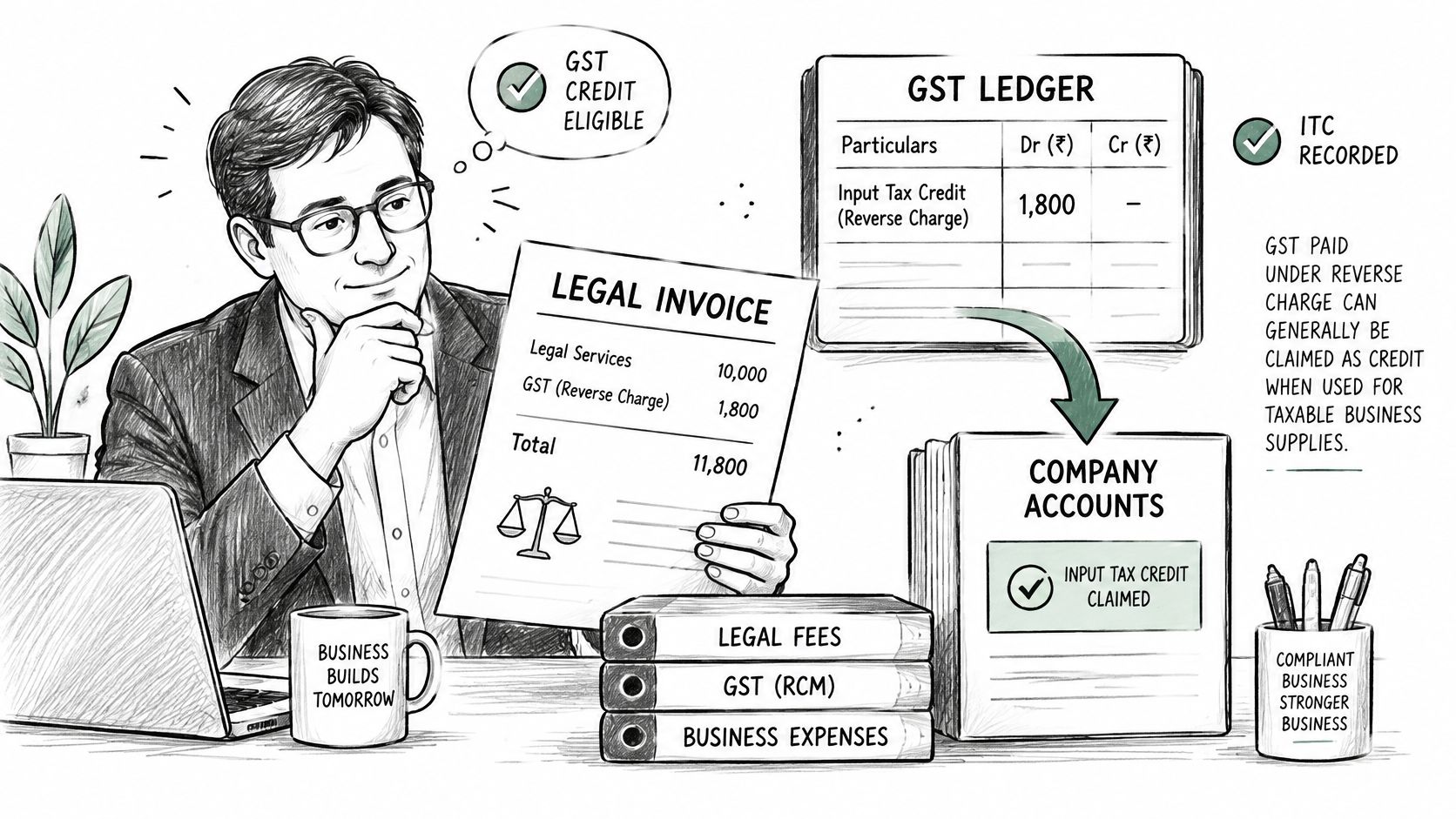
A recipient can pay reverse-charge GST and hold an eligible credit without recovering that cash immediately. Credit availability is not the same as a cash refund, and it doesn't erase the funding needed to discharge the reverse-charge liability.
For example, a company may pay tax on legal advice used in its taxable business and claim eligible credit in the relevant return. Whether that credit reduces another cash payment depends on its output liability and the permitted utilisation, so describing the transaction as having no GST cash outflow would mislead the finance team.
Check business use and eligibility separately
Review the entitlement under the CGST Act, including the applicable credit conditions and restrictions. Payment of tax is necessary to the analysis, but it isn't the only question.
- Business connection: Tie the legal assignment to the recipient's business activity rather than relying on the company's name on the bill.
- Personal element: Separate a director's private dispute from work received by the business.
- Restricted or mixed use: Examine blocked-credit provisions and any allocation needed for taxable, exempt or non-business use.
- Supporting records: Retain receipt-of-service evidence, the correct invoice documentation, payment support and return treatment.
The supplier's own credit position needs a separate review. Don't assume that research subscriptions, software or counsel costs produce usable credit merely because they support a professional practice; examine the nature of its outward supplies and the applicable restrictions.
The accounting review should keep the invoice and tax-payment evidence connected.
Use reconciliation without making it the legal test
Match the purchase register against GSTR-2B where the document is expected to appear. Don't assume every reverse-charge transaction, particularly one involving an unregistered supplier, will appear in the same way as an ordinary supplier-reported invoice.
A match doesn't prove eligibility, and absence doesn't automatically settle ineligibility. Investigate the reporting route and documentary requirements before accepting a software exception as the tax conclusion.
Charter AI uses rules for GST matching, GSTIN and PAN checks, voucher-balance checks, statutory due dates, tax-audit checks, its free tools and Excel exports. Use those controls to identify entries requiring attention, while keeping the credit decision with the professional reviewing the business use and legal conditions.
Responding to a GST Scrutiny Notice
Check the notice before drafting the defence. Compare the taxpayer identity, GSTIN, attachments, periods, allegations and relied-upon documents; a reported GSTAT decision found that a demand summary accompanied by a notice addressed to another taxpayer wasn't a valid show-cause notice, according to the Taxscan case digest.
Identify the procedural stage
Under section 61, an accepted explanation can close scrutiny without further action, while failure to give a satisfactory explanation within 30 days, or a further permitted period, can allow escalation under the CGST Act. Confirm the documented receipt date and assign the response deadline rather than relying on when someone forwarded the email.
Rule 99 links return scrutiny to Form GST ASMT-10 when the officer identifies discrepancies, as set out in the CGST Rules_rules_2017.pdf). Keep a scrutiny explanation distinct from a demand-stage reply.
Build the response through the GST scrutiny and ASMT-10 workflow using a discrepancy matrix:
- Allegation: Record the officer's issue and computation.
- Evidence: Link the return, ledger, invoice, payment record or earlier clarification.
- Conclusion: Mark the difference as admitted, disputed or awaiting evidence.
- Tax effect: Separate output tax, credit, interest and penalty computations.
A persuasive legal argument still needs arithmetic the officer can reproduce.
Preserve the timeline
Don't assume the latest appeal requirement necessarily governs an older proceeding. A reported Delhi High Court ruling treated the notice date as commencement and declined to apply the 10% pre-deposit introduced from 1 October 2025 to an earlier-notice penalty-only matter, according to the Legal 500 tax alert.
Verify the judgment and its applicability before relying on that position, and preserve limitation while assessing alternative filing approaches.
Re-check the Tax Decision at Every Invoice
Approve the treatment at engagement acceptance, then check whether the facts have changed before billing. The useful control isn't repeated legal research on an unchanged matter; it's a short exception review that catches a different recipient, establishment, scope or payment arrangement.
Require fresh approval when the client changes its contracting entity, the work moves to another establishment, an additional service enters the engagement or an expense appears without supporting authority. Keep the revised conclusion dated so reviewers can distinguish a genuine change in facts from inconsistent billing.
Make the review part of the workflow
Charter AI provides an unlimited client compliance calendar covering GST, TDS, ITR and client deadlines, with reminders 7 days before, 1 day before and on the day. Use the calendar alongside the matter file so the person approving tax treatment and the person responsible for filing can see the same outstanding work.
The platform provides general information and workflow support, not legal or professional advice. Eden Labs isn't a law firm and doesn't practise law; a qualified professional must confirm the treatment for the specific engagement.
Pick one open client today. Review its next bill, resolve any unsupported assumption and save a dated decision note with the engagement documents.
Charter AI combines source-linked tax research, notice drafting, GST reconciliation and client compliance tracking in one workspace. Visit Charter AI to organise the invoice evidence, review reconciliation exceptions and keep the next legal-fee tax decision connected to the client's filing work.