
GST ASMT 10 Reply Format in Word: Clause-by-Clause Sample
A clause-by-clause GST ASMT 10 reply format in Word with facts, legal position, grounds, prayer, annexure index and filing steps.
Published 18 min read
You've downloaded the ASMT-10 as a PDF, opened a blank Word document, and typed the subject line. The cursor is blinking underneath it, and the temptation is to write a polite letter saying the returns were filed correctly and requesting closure.
That letter is the most common reason a scrutiny reply fails. The officer didn't send a general notice. They sent numbered observations, most with a figure attached, and a general covering letter answers none of them. What closes the file is a scrutiny workpaper package: a Word document that mirrors the notice clause by clause, proves each figure against a return extract, and leaves an audit trail the department can follow months later.
What follows is the structure I use for a GST ASMT 10 reply format in Word, clause by clause, with sample wording, the annexure index, and the filing sequence that keeps the Word file and the portal response in step.
Table of Contents
- What Rule 99 Requires in Your Reply
- Word Template Structure for an ASMT 10 Reply
- Facts and Legal Position Clauses, Annotated
- How the working sits inside the facts clause
- Discrepancy-Wise Response Block for Each Issue
- A worked block for a timing difference
- The matrix that holds the blocks together
- Annexure Index and Schedules to Attach
- Label, order and upload discipline
- Partial Acceptance and Keeping the Audit Trail
- How to File the Reply and Attach the Word Draft
- Confirm the Reply Package Before You File
What Rule 99 Requires in Your Reply
The trigger is mechanical. A return is selected for scrutiny under section 61 of the CGST Act, 2017, the proper officer compares it with the information available to the department, and where the figures don't reconcile the gap is recorded in FORM GST ASMT-10. Rule 99(1) of the CGST Rules requires that notice to communicate the discrepancy and, where possible, quantify the tax, interest or other amount payable. The reply is generally due within 30 days from the date of service, though the proper officer may permit a further period.
Read the notice with both obligations in mind. The department has to name what it found and put a number on it where it can. You have to answer each named item with a number of your own and the document that supports it.
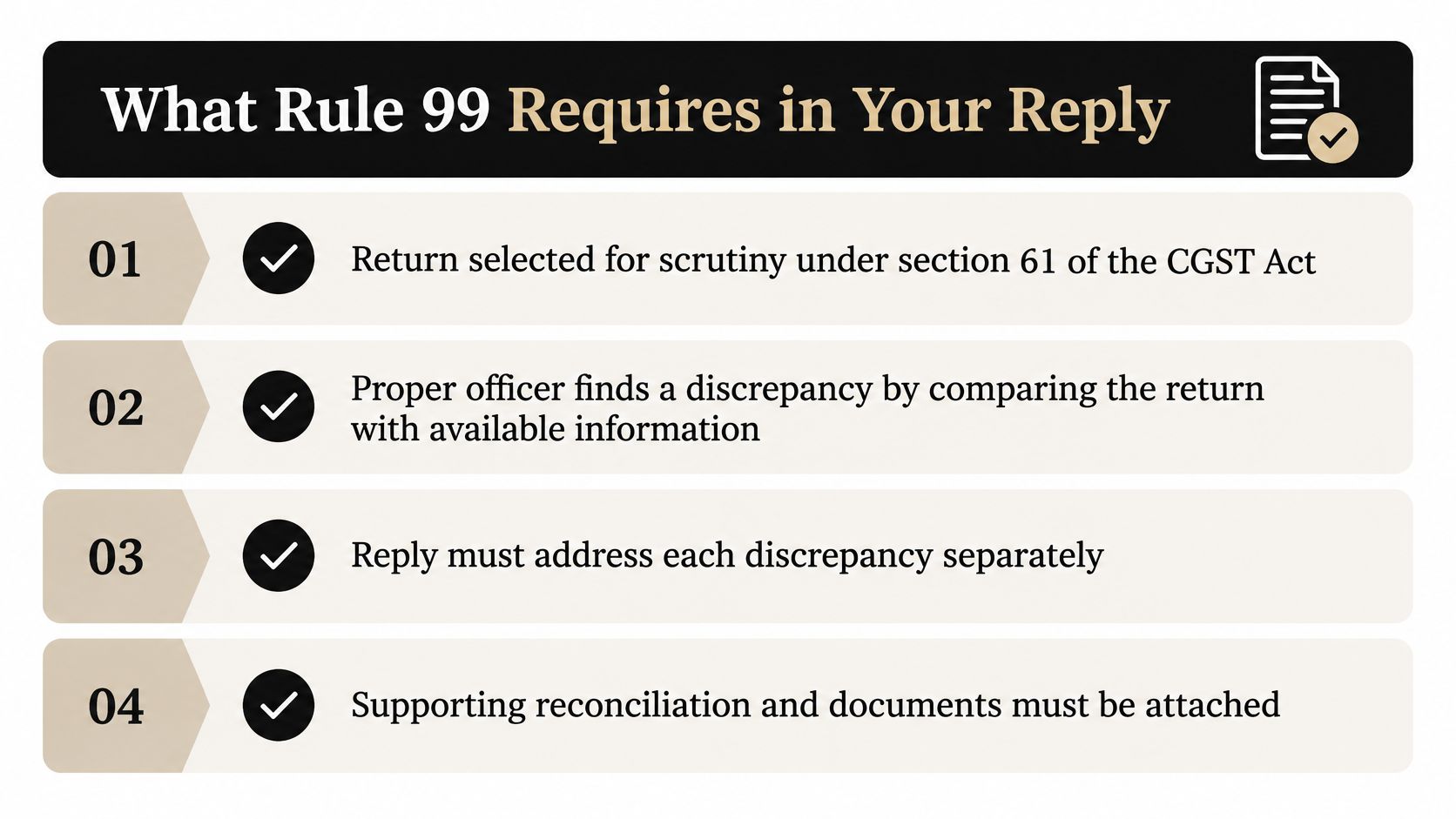
Four checks come before any drafting.
- Diary the deadline on the day of service. Record the date of service and the original expiry in the file note, even if you intend to seek more time. An extension you meant to request is not an extension.
- Verify the identifiers against the PDF. GSTIN, legal name, tax period, notice reference number and notice date. A transposed digit in the reference number is the fastest route to having your reply matched to the wrong notice.
- Separate quantified from unquantified paragraphs. Some paragraphs carry an amount, others describe a pattern of mismatch with no figure at all. Both need a response, but only the first needs a reconciliation total.
- Allocate one response per discrepancy. Facts first, law second, evidence third. A single blended narrative falls apart the moment the officer reads paragraph 3 of the notice.
The test I apply: if the officer can't place your reply paragraph beside the notice paragraph and see them line up, the draft isn't finished.
Keep the boundary between the two documents clear. The response you file is FORM GST ASMT-11 on the portal. The Word file is the detailed submission behind it, and Rule 99 of the CGST Rules, 2017 is the provision on which both the notice and the reply stand.
Word Template Structure for an ASMT 10 Reply
The reply is a structured submission. CBIC's assessment and audit rules provide for the response in FORM GST ASMT-11, and in practice that response is organised discrepancy by discrepancy and supported by reconciliations. Draft the Word file as a scrutiny workpaper package: a covering structure up front, each clause carrying the observation, the reconciliation and the evidence behind it.
Here is the full clause map, in the order the document should run.
| Clause | Purpose | What to write |
|---|---|---|
| Front-page metadata | Identifies the notice and taxpayer | GSTIN, legal name, notice number and date, tax period, jurisdiction |
| Facts | Sets out the record | Notice particulars, returns filed, amounts alleged |
| Legal position | States the statutory basis | Section 61 scrutiny, Rule 99, limitation where the dates support it |
| Grounds | Explains why the allegation fails or is partly accepted | One ground per discrepancy |
| Discrepancy-wise response | Answers each observation separately | Observation, explanation, reconciliation, evidence |
| Annexure index | Maps each figure to a document | Annexure letter, document, page or row reference |
| Prayer | Requests a specific outcome | Closure of the explained part; admitted amounts paid through DRC-03 before filing |
| Undertaking and signature | Confirms accuracy | Authorised signatory name, designation, date, place |
The order is deliberate. An officer reads the reply with the notice open beside it, so particulars come first, the working sits in the middle, and the request closes the document. A reply that buries the discrepancy response under pages of preamble makes the officer search for the one thing they opened the file to find.
Two habits keep the template usable across a busy practice. The first is that clause headings follow the notice wording, so the officer can match paragraph to paragraph without hunting. The second is one master file per notice, with the clause headings frozen from the first draft onwards.
Naming rule: clause headings stay identical from v1 to v5. Version control belongs in the file name and on the front page, never in the headings, because the officer is matching structure, not reading a revision history.
Treat the clause map as fixed once it is set. Facts, grounds and the annexure index stay in the same positions in every draft, which is what lets the package survive multiple revisions without losing its audit trail.
Facts and Legal Position Clauses, Annotated
The facts clause is where a reply earns or loses credibility. It's read first, before any argument, and it either matches the notice or it doesn't. Here is a workable opening for the sample notice used throughout this piece.
Facts
- The notice in FORM GST ASMT-10 bearing reference [number] dated [date] was issued under section 61 of the CGST Act, 2017 for the tax period April 2026 to September 2026.
- This reply is filed within the time allowed, the deadline stated in the notice being 30 October 2026.
- The notice alleges a difference of ₹13,20,000 between the outward supplies declared in GSTR-1 and the tax declared in GSTR-3B for the said period.
Note what the third paragraph does. It states the allegation at its full value, in the officer's figure, before any rebuttal. That single discipline buys more credibility than a page of protest.
How the working sits inside the facts clause
Of the ₹13,20,000 alleged, the reconciliation in the same sample accounts for ₹10,94,259 across three reasons, and leaves ₹2,25,741 unexplained. Both figures go into the facts clause and again into the prayer. The unexplained balance is stated as unexplained, not folded into the explained figure and not rounded into a tidy total. An officer who finds an honest ₹2,25,741 open will read the explanation of the ₹10,94,259 with far more patience than one who finds the whole amount waved away.
Then comes the legal position, stated once, next to the facts it governs.
Legal position
- The notice is issued under section 61 of the CGST Act, 2017 read with Rule 99 of the CGST Rules, 2017, which confines the enquiry to the discrepancies communicated in the notice.
- Each discrepancy is answered on the return data and books of account for the period, reconciled in Annexure A.
- The proceedings are barred by limitation, the period for passing an order having expired.
That third point is the one to handle with care. A sample reply can argue that the proceedings are barred under section 73(10) because the period for the order has run out, but the argument only holds if the notice dates support it. An ASMT-10 issues under section 61, not under section 73, so confirm from the notice and the record which provision would govern any resulting demand before you put a limitation plea in writing. A limitation argument that fails on its own dates weakens the parts of the reply that are sound.
Figure rule: every amount carries Indian digit grouping (₹10,94,259, not ₹1,094,259) and cites its annexure in the same sentence. A figure with no annexure is an assertion.
Discrepancy-Wise Response Block for Each Issue
Build the body of the reply as one repeatable block per observation, in this order: observation in ASMT-10, taxpayer's factual response, reconciliation or calculation, legal position, evidence relied upon, conclusion and prayer. The order is deliberate. The officer reads the observation they wrote, your answer to it, the arithmetic that supports the answer, the provision, the document, and the outcome you want, all within one page. That structure mirrors the ASMT-10 allegations and preserves an audit trail that survives a later audit, a show-cause notice or an investigation under the CGST Rules, 2017.
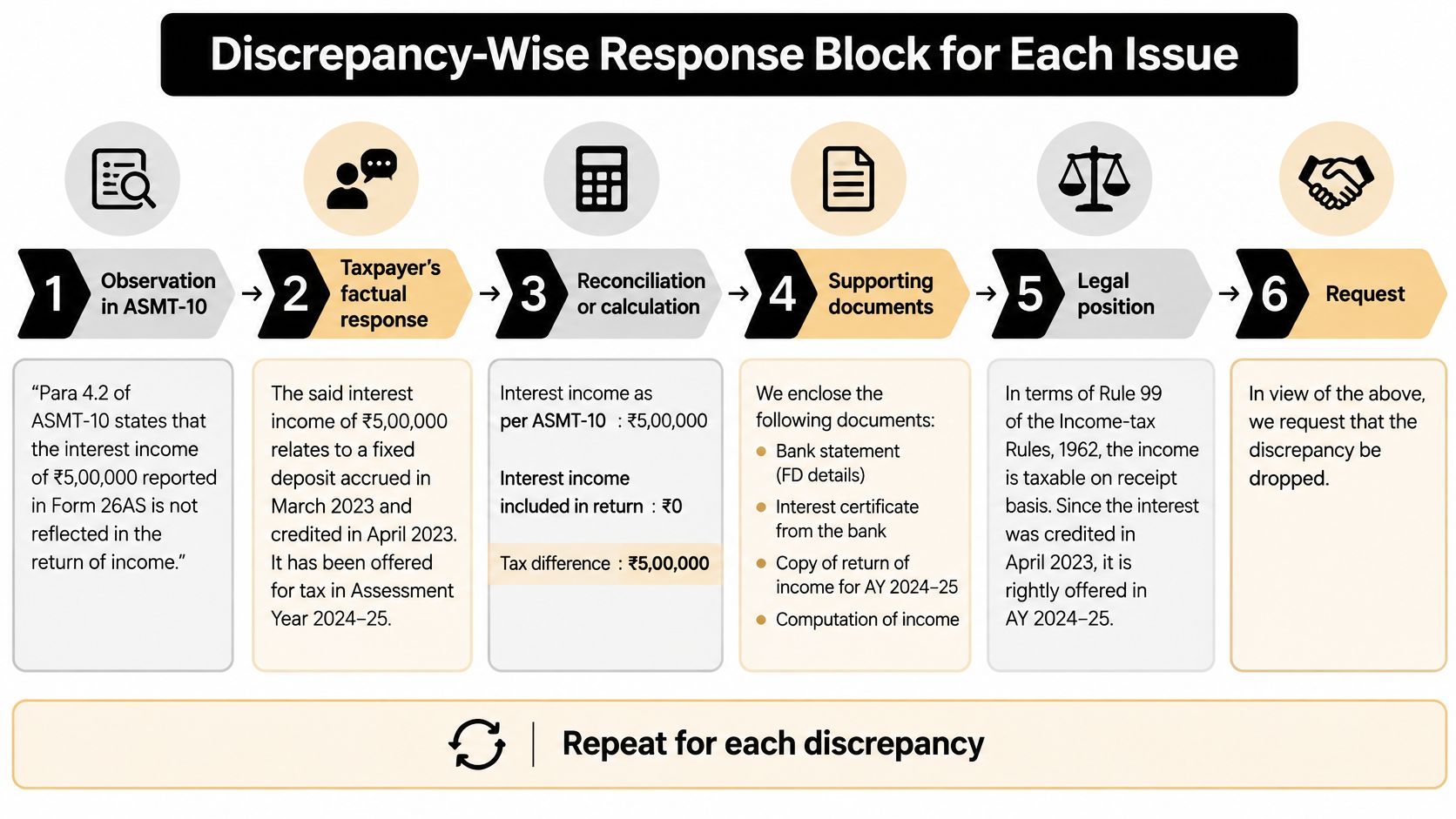
Repetition is the point. An officer verifying the file opens the notice at observation 2, finds your block 2 on the corresponding page, and checks one figure against one annexure row. That is a ten-minute verification instead of an afternoon of cross-reading, and replies that are quick to verify tend to be accepted.
A worked block for a timing difference
Take a common item. An invoice dated August 2026 was reported in the September return. The supply sits in the correct financial year, only the month of reporting differs, and neither the tax period of the supply nor the tax amount is affected.
The block answers it in sequence. The observation quotes the notice paragraph on the GSTR-1 and GSTR-3B gap for August. The factual response identifies the invoice and its date. The reconciliation shows the invoice moving from the August column into September and demonstrates that the closing position for the half-year is unchanged. The legal position points to the reporting requirement, not to a change in liability. The evidence cites the invoice, the e-invoice extract and the relevant return rows. The conclusion asks for the item to be treated as a confirmed month correction, not a short payment.
The matrix that holds the blocks together
Every block also gets a row in an observation-wise matrix, kept on a single page at the front of the annexure set. It's the page an officer uses to review the file, and the page a reviewing partner uses to see the whole reply at a glance.
| Notice paragraph | Taxpayer response | Disputed amount | Annexure | Requested conclusion |
|---|---|---|---|---|
| Difference between GSTR-1 and GSTR-3B | Explained through three reasons set out in Annexure A | ₹10,94,259 explained | Annexure A | Closure of the explained amount |
| Balance of the alleged difference | Not explained in the sample working; accept, pay or contest after checking | ₹2,25,741 | Annexure A, plus Annexure J if paid | Stated position on the balance in the prayer |
| Invoice dated August 2026 reported in September return | Same year, month differs; tax period and tax amount unaffected | Nil, tax period and amount unchanged | Annexure H | Confirmed month correction |
Two drafting habits keep the matrix honest. Quantify tax, interest and other amounts separately rather than as a rounded composite, and label a factual mismatch differently from an admitted shortfall. They attract different relief: one is explained away, the other is paid.
Before converting the .docx, check that the tables, annexure labels and numeric totals are stable, the file is searchable and paginated predictably, and the signatory details sit on the page the signature appears on.
Annexure Index and Schedules to Attach
The annexure index is a cross-reference system, not a document list. Every figure in the body points to one annexure letter, and every annexure letter carries a page or row number so the officer lands on the exact line. Build the index as a table, and use it as the attachment checklist before the file goes anywhere.
In the sample running through this piece, the whole alleged difference of ₹13,20,000 between GSTR-1 and GSTR-3B for April to September 2026 sits in three reasons, and all three are set out in Annexure A. Everything after A is source material that proves it.
| Annexure | Document | Used to prove |
|---|---|---|
| A | Difference schedule with each reason | Explains the whole alleged difference |
| B | GSTR-1 extract for each month | Outward supplies as filed |
| C | GSTR-3B extract for each month | Tax declared and paid |
| D | GSTR-2B statement | Inward supplies and ITC available |
| E | Sales register | Invoice-level outward supplies |
| F | Purchase register | Invoice-level inward supplies |
| G | Credit and debit note register | Adjustments to reported values |
| H | E-invoice and e-way bill extracts | Invoice reference and transport details |
| I | Electronic credit ledger extract | ITC utilised and balance |
| J | Payment challans or DRC-03 receipts | Amounts paid for admitted items |
Label, order and upload discipline
Attach only the months and returns the notice concerns. A six-month notice gets six months of extracts, not three years. Label each file with its annexure letter before uploading, so the uploaded file name and the index match without a mapping sheet that nobody reads.
Keep the letter order identical in the Word file and the uploaded PDF. If a document can't be found, say so in the reply with the reason, rather than dropping the reference. A missing reference reads as a missing explanation, and the officer will ask for it anyway, usually with less patience the second time.
Partial Acceptance and Keeping the Audit Trail
Partial acceptance is a decision, not a fallback. Where part of a discrepancy is correct, pay the admitted amount through Form GST DRC-03 and contest the balance in the same reply, so the officer sees a clean split rather than a blanket denial. In the sample working, ₹2,25,741 is the amount the reconciliation doesn't explain, and that is the figure to accept, pay or contest on evidence. The prayer then matches the split: closure for the explained amount and a stated position on the balance.
The portal's own DRC-03 guidance makes the sequencing matter. An ASMT-10 reference number is not populated once the ASMT-12 drop-proceedings order or a recommendation has been issued, which is why the combined accept, explain and contest strategy described in the portal's DRC-03 user manual works better than a simple denial letter. Pay the admitted part while the reference is live.
Then keep the trail, because a polished letter with no trail is hard to prove as timely. For each filing, hold together the portal acknowledgement, the uploaded PDF with a version label such as v1 or v2, the source Word file, a dated chronology of portal actions, the DRC-03 challan, and the annexure set exactly as uploaded. The GST portal's taxpayer dashboard guidance confirms that notices and orders stay available to view and download, so treat the submission as a traceable electronic record rather than ordinary correspondence.
For revised submissions or multiple notices, label each version with its date and the reason for the change. If the matter later moves to a show-cause notice under section 73, that chronology is the first thing you'll reach for.
How to File the Reply and Attach the Word Draft
FORM GST ASMT-11 is the prescribed response, and it's worth being blunt about that. Rule 99(2) lets the registered person either accept the discrepancy and pay the resulting tax, interest or other amount, or furnish an explanation to the proper officer, as set out in CBIC's assessment and audit rules for scrutiny. Payment for an accepted item goes through FORM GST DRC-03. The workflow then runs from the ASMT-10 notice to your ASMT-11 reply and on to ASMT-12 acceptance, a show-cause notice, or audit and investigation action. A good Word draft supports that portal response. It doesn't replace it.
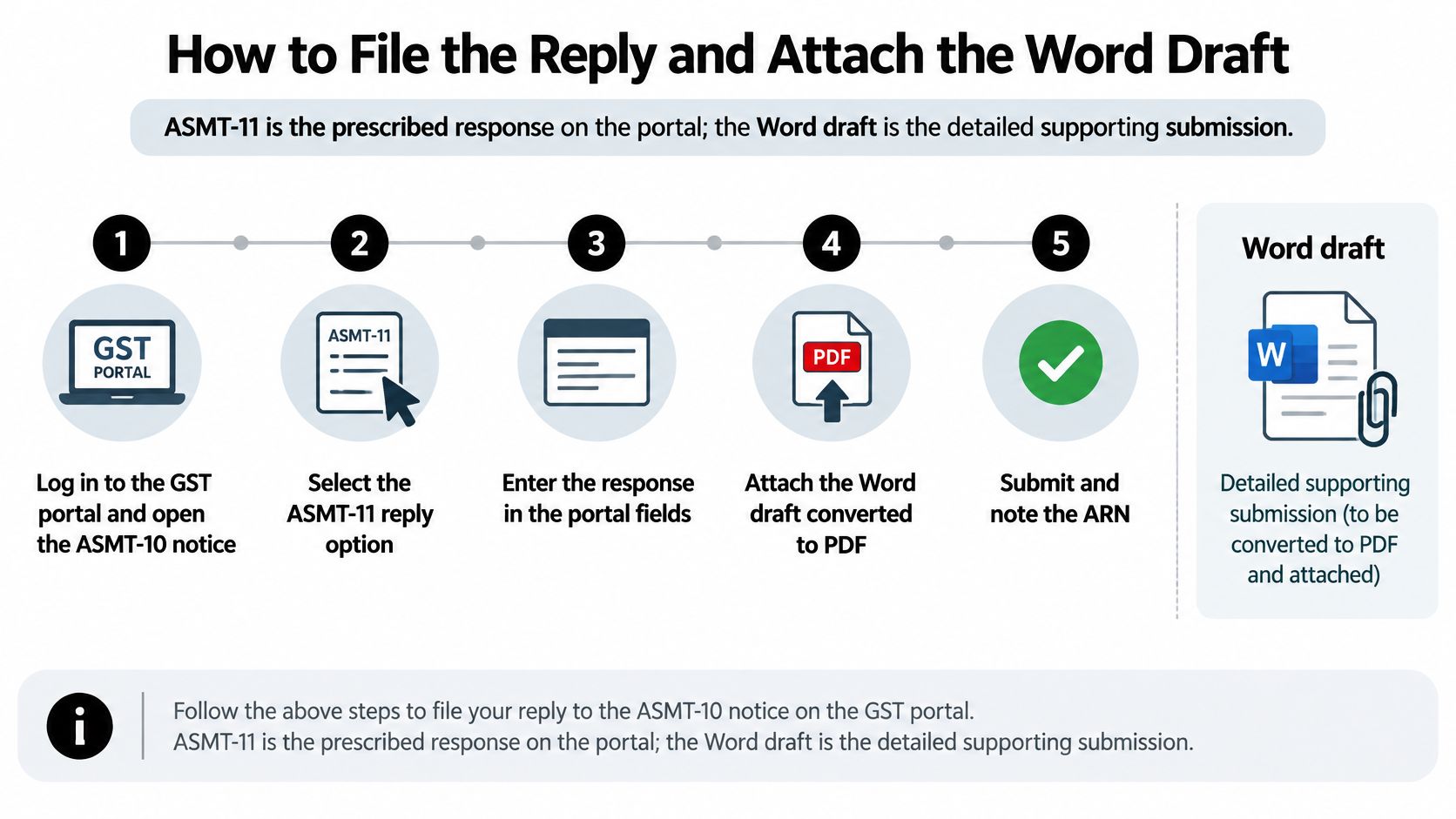
The sequence that works:
- Log in to the GST portal and open the ASMT-10 from the notices and orders view. Download the PDF again if the printed copy is the only one you have.
- Match identifiers before anything else. GSTIN, tax period and notice reference in the Word draft against the notice on screen, at the same time, on the same screen.
- Decide each discrepancy as accepted, explained, or partly accepted. Write the decision on the matrix before opening the portal form.
- Pay the accepted amounts through DRC-03 and keep the challan. Clear the admitted liability before the explanation goes in, so the accepted figure can't drift.
- Prepare the ASMT-11 explanation and upload the verified PDF of the Word draft with its annexures in the index order.
- Submit before the deadline the notice set, or the extended date the proper officer permitted.
- Save the acknowledgement and watch for the next step: ASMT-12, a show-cause notice, or audit action.
The order carries meaning. Paying the admitted part first keeps the accepted amount clean and separates it from the contested sum in the officer's mind. Checking the PDF before upload keeps the tables and totals identical to the Word source, because the portal copy is the one that becomes the record.
Extension discipline: if the reply can't be filed in time, request a further period from the proper officer before the original date passes, then record the request, the response and the date of any extension in the trail.
If a point remains disputed after the reply, ask for a personal hearing before any adverse view is taken; the practice around written submissions for a personal hearing under section 75(4) applies the same way at that stage.
Confirm the Reply Package Before You File
Run this check as pass or fail, and stop the upload on a single failure. Our notice reply deadline tool shows the last day to reply for a given notice and its dates, which settles item one in seconds.
- Metadata matches the ASMT-10 for GSTIN, legal name, notice number and date, tax period and jurisdiction.
- Every figure cites an annexure letter that exists in the index, with letters in the same order in the Word file and the PDF.
- Every block carries all five parts: observation, factual response, reconciliation, legal position, prayer.
- The signature block is complete, with the authorised signatory's name, designation, date and place, and the accuracy undertaking above it.
- The DRC-03 challan is attached for each admitted amount, and admitted and contested sums appear separately in the prayer.
- Tables and totals are re-checked after conversion, so the PDF matches the source exactly.
A failure means correcting the Word source and regenerating the PDF, not patching the PDF. The copy on the portal and the copy in your audit trail must be the same document.
Charter AI drafts exactly this package: upload the ASMT-10 with the returns, e-way bills and sales registers, and it drafts a reply in the prescribed form with facts, legal position, grounds and prayer, where each paragraph points to its line in the annexure, then exports to .docx so you can review and file it in ASMT-11. If you're building replies by hand at the rate of a few a week, that drafting head start is where the hours come back. Visit Charter AI to see how the notice workspace handles your next scrutiny notice.