
CA Practice Management Software That Fits Indian Firms
Discover CA practice management software built for Indian firms. Streamline compliance, client work, and billing in one platform designed for your workflow.
Published 17 min read

It's 9.15 on Monday and your senior wants a notice reply by evening, GST reconciliations are waiting, and a junior is hovering with a Tally voucher query. That's not a feature problem. It's a workflow problem, and it should decide the software you buy.
Table of Contents
- A Monday Morning in a CA Firm and Why Software Choice Matters
- Four pressures hit at the same time
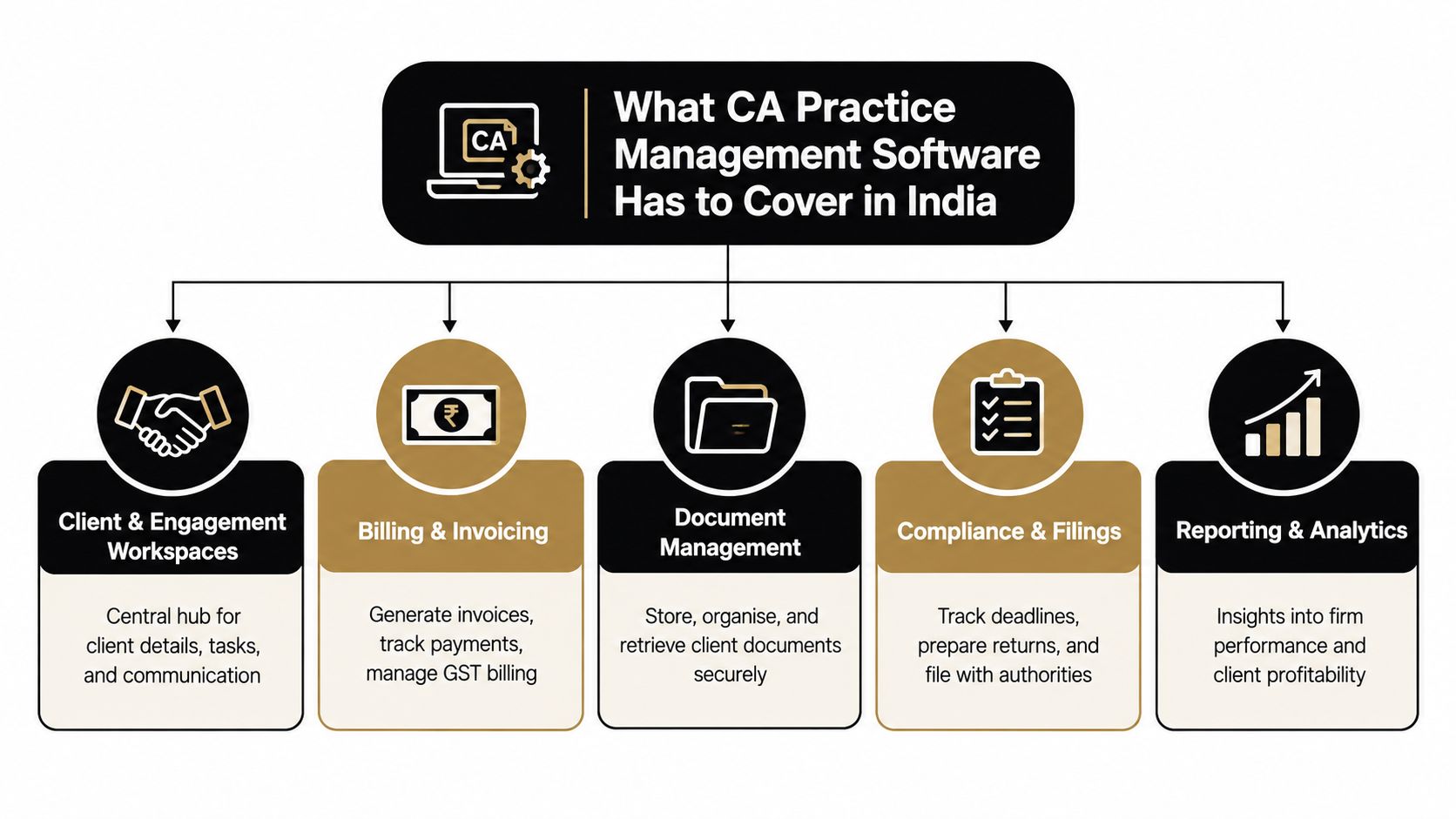
- What CA Practice Management Software Has to Cover in India
- The non-negotiable modules
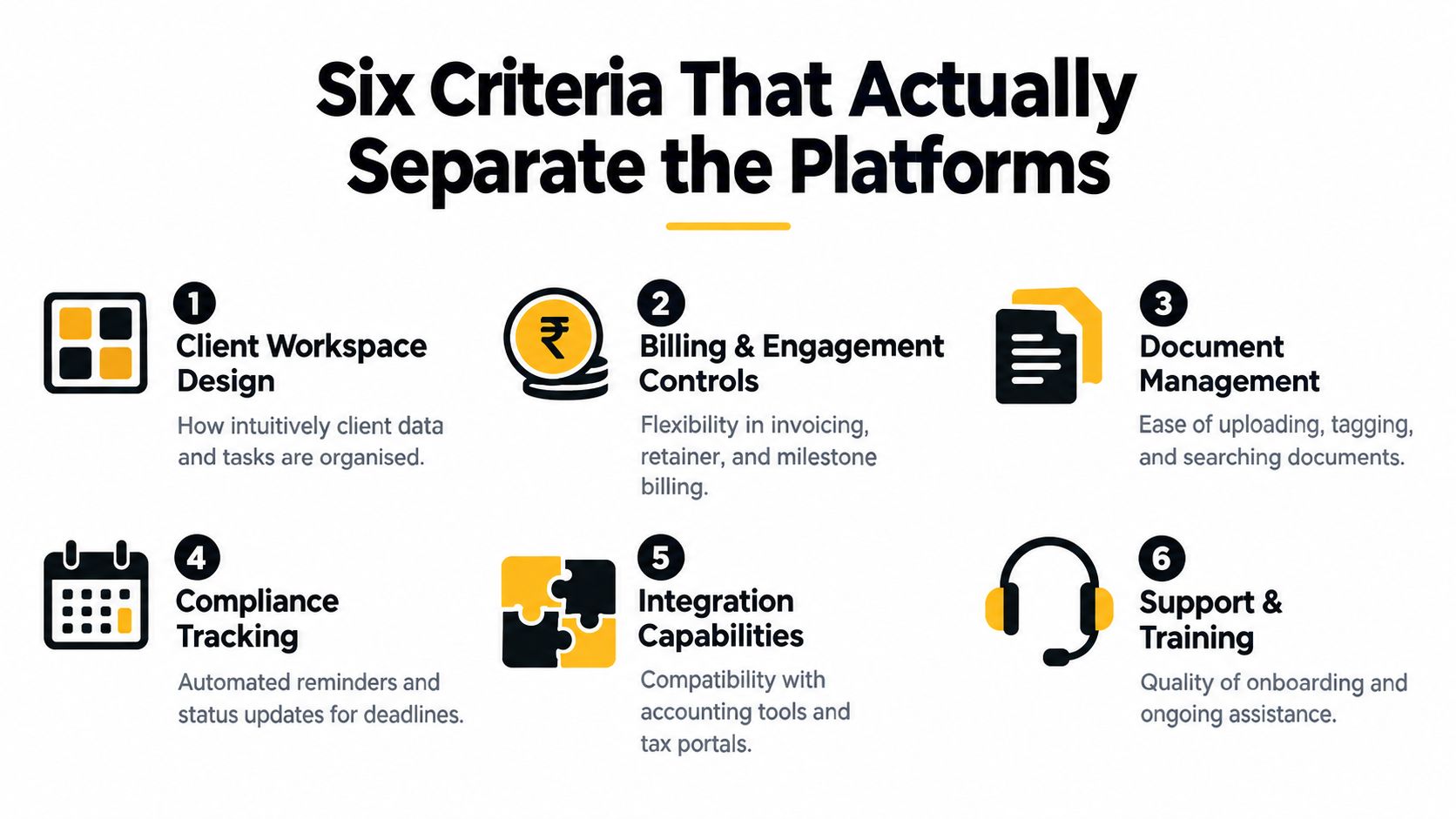
- Six Criteria That Actually Separate the Platforms
- What to test, criterion by criterion
- How the Major Indian Platforms Stack Up
- Trade-offs the table can't show
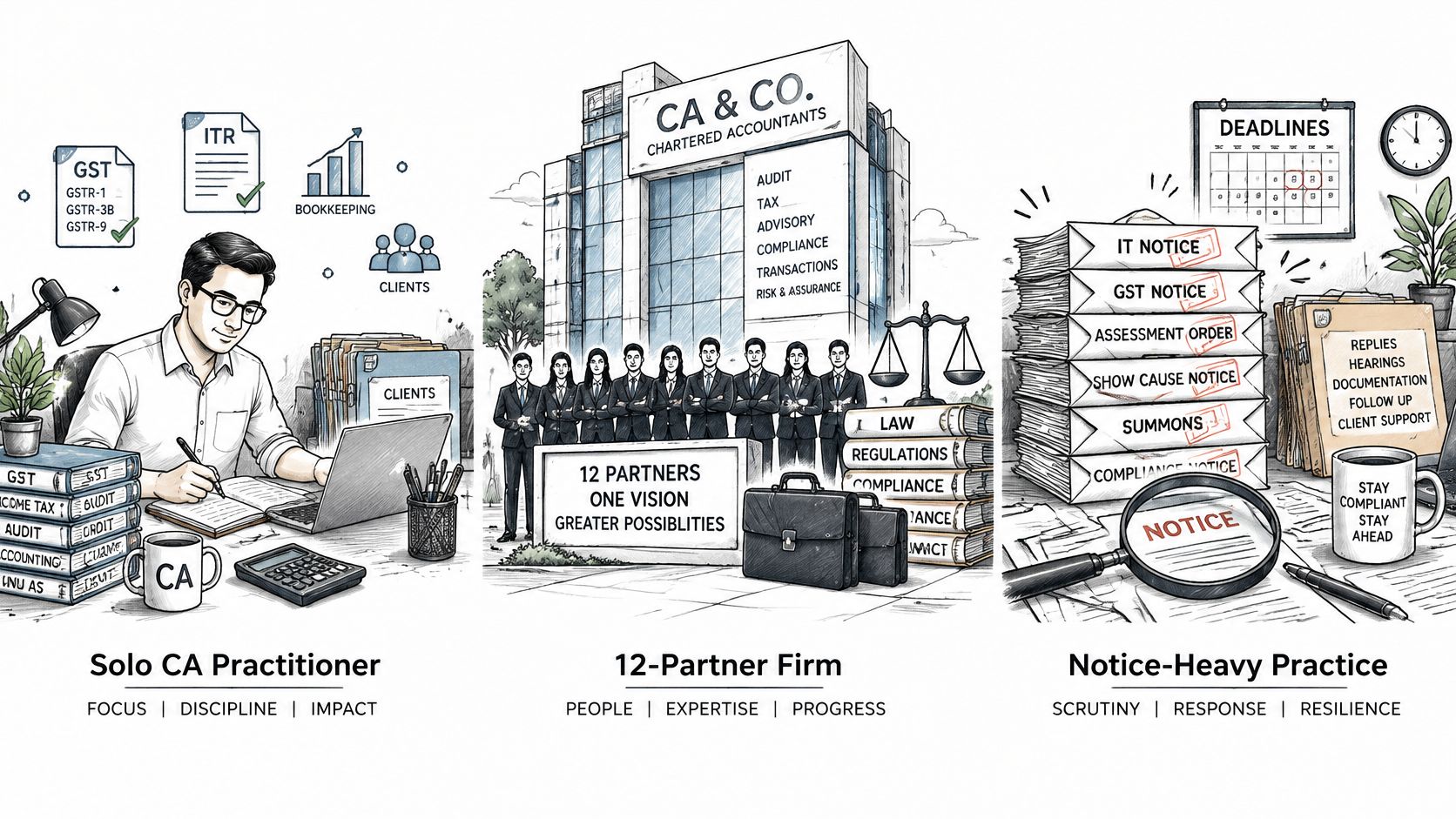
- Three Real Firm Profiles and Their Best Fit
- Solo practitioner with a GST and bookkeeping book
- Twelve-partner firm with audit and litigation mixed in
- Notice-heavy practice under departmental scrutiny
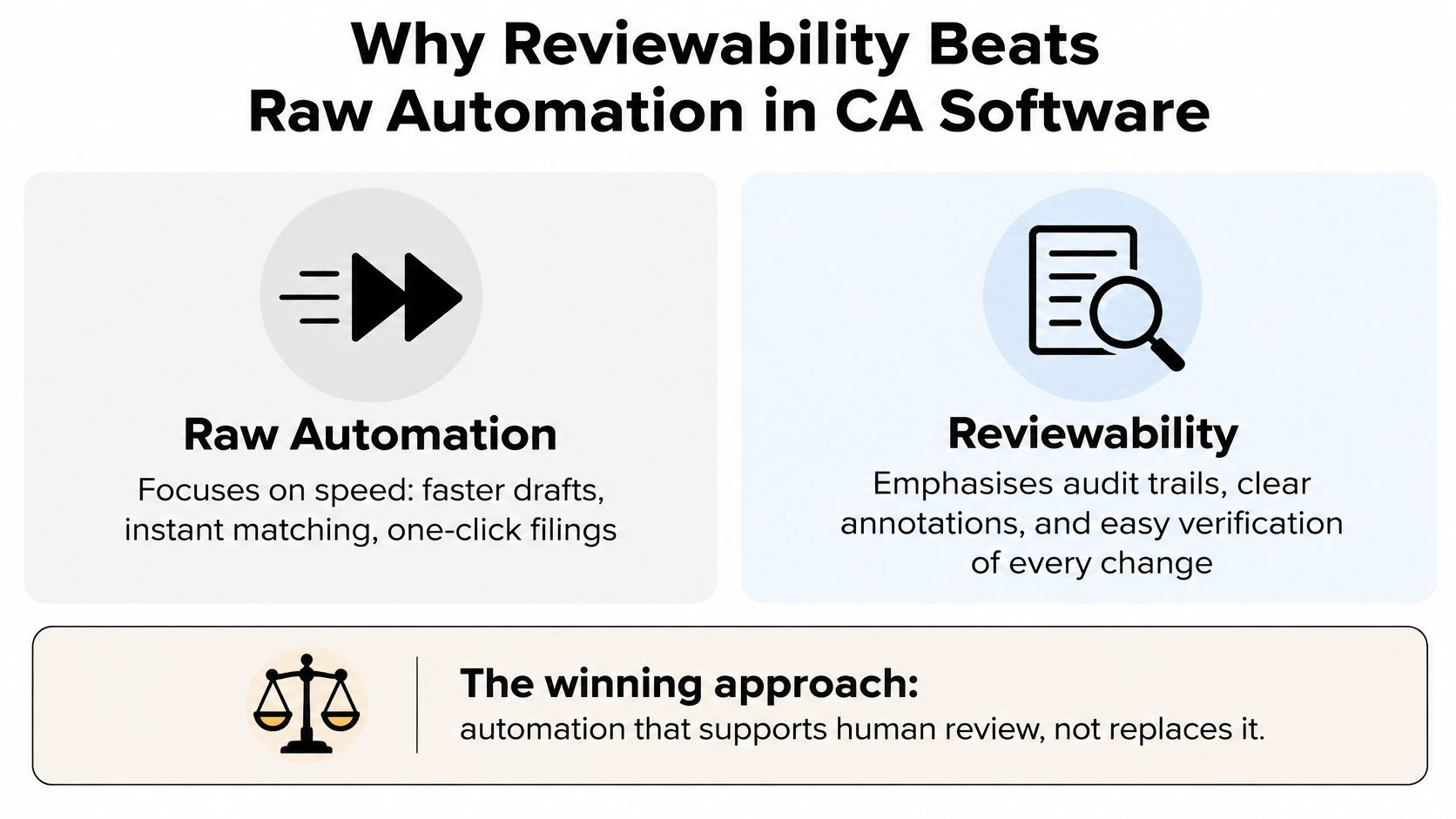
- Why Reviewability Beats Raw Automation in CA Software
- What good reviewability looks like
- A 30-Day Evaluation Protocol You Can Run Before Signing
- Week 1 for data ingestion and workspace setup
- Week 2 for GST reconciliation under live load
- Week 3 for drafting, review and bookkeeping
- Week 4 for security, access and exit
- Direct Recommendations for the Three Firm Profiles
A Monday Morning in a CA Firm and Why Software Choice Matters
The partner walks in with a scribbled list. One notice reply must leave today, two clients need GSTR-2B reconciliation before filing, and three deadlines sit inside this week across GST and TDS. Before the first file opens, the article clerk asks which purchase voucher to post in Tally and where the supporting invoice is saved.
Nobody in that room lacks competence. The friction comes from switching context. The notice sits in email, the ledger sits in TallyPrime, the reconciliation lives in a spreadsheet, and the client's bank statement is buried in a shared folder with a filename nobody agreed on.
Four pressures hit at the same time
Drafting under deadline means you can't start from a blank page and hunt for facts across PDFs. You need the notice, annexures, returns and ledgers already tied to the client, with every amount traceable to a page you can open during partner review.
GST reconciliation is now an exception exercise, not a full manual match. Staff should spend their morning on missing and mismatched entries, not proving that clean invoices match. If your CA practice management software can't classify matches and surface exceptions, your team is doing work the system should've done.
Deadline visibility has to be client-wise and automatic. A partner shouldn't need to ask who is pending. The calendar should show, by registration type, what is due, what is filed, and what is blocked on client documents.
Evidence quality ties the other three together. When a notice arrives months later, you need the invoice, the reconciliation decision, the approver and the filing acknowledgement in one place. Reconstructing that trail from inboxes is slow and risky.
The right test isn't whether a demo looks tidy. It's whether your worst Monday gets calmer.
That reframes the purchase. You're not buying task lists, billing screens or a prettier dashboard. You're buying one client workspace where drafting, reconciliation, bookkeeping, documents and deadlines stay connected. If staff still bounce between Tally, the GST portal, Excel and a folder tree, you haven't bought practice management. You've bought another tab.
What CA Practice Management Software Has to Cover in India
Start with the market you're in. ICAI data reported for 1 October 2025 recorded 100,138 registered CA firms employing 183,642 professionals, and sole-partner firms made up 72.6% of firms. Software built only for large accounting departments misses most Indian practices, which run lean and need several jobs inside one system.
The non-negotiable modules
- Client and engagement workspaces: Every task, document, return and draft should sit under the client, not under a staff member's personal system. When someone resigns, the work history stays with the firm.
- Billing and time tracking: Fees should connect to engagements and completed work, so partners can see unbilled effort before it becomes an awkward year-end conversation.
- Document management: Search, tagging, permissions and an audit trail matter more than storage space. A vault you can't search is just a neater dumping ground.
- Compliance calendar: Deadlines must auto-populate from registration type and filing frequency. A calendar your team types by hand will drift within one busy month. Keep a public due dates reference for cross-checking deadlines during setup, then make the system own the recurring work.
- GST reconciliation: The platform must handle GSTR-2A and 2B, purchase registers, e-invoices and e-way bills together, then classify results as matched, probable, missing or mismatched.
- AI-assisted drafting: Notice replies, opinions and appeals need structured output that separates facts, legal position, grounds, arguments and prayer, with export to Word and PDF for final review.
- Bookkeeping and TallyPrime export: Bank statements and invoices should become suggested vouchers with ledgers proposed, rules applied and duplicates blocked before export. Unlimited pushes matter because per-document pricing changes staff behaviour in the wrong direction.
Treat this list as acceptance criteria, not marketing copy. If a vendor calls something practice management but leaves reconciliation in Excel, drafting in Word and documents in email, it's an office organiser. That's useful, but it's not the same purchase and shouldn't be priced or judged as one.
Six Criteria That Actually Separate the Platforms
An India-focused industry report estimates approximately 28% of CA firms use cloud-based practice-management tools, only 12% have workflow automation beyond basic email rules, and fewer than 8% operate client portals. It also puts primary reliance on desktop software at roughly 65%. In plain terms, most firms are still bridging old and new systems, so interoperability can't be an afterthought.
What to test, criterion by criterion
1. Client workspace design. Open one messy client and count clicks to reach the latest return, open notice, pending documents and filing status. Weak design forces staff to know where things are. Strong design makes location obvious to a new joiner.
2. Billing and engagement controls. Check retainers, milestone fees, out-of-scope work and approval before invoicing. If billing can't reflect how you charge for notices versus recurring compliance, partners will keep a parallel spreadsheet and the data will rot.
3. Document management and retrieval. Upload a scanned invoice, a bank statement and a notice PDF, then search by amount, GSTIN and client name. Test permissions too, because client-wise access is where shared folders usually fail. A proper bank reconciliation workflow should also leave matched statements retrievable later, not stranded in a one-off utility.
4. Compliance calendar accuracy. Add a regular dealer, a composition client and a cancelled GSTIN. Correct software creates different obligations for each and stops tasks where registration has ended. Manual date entry isn't automation, whatever the brochure says.
5. Security and access control. Ask who can see portal credentials, download bulk documents, change a filed status or delete evidence. Role-based access, encryption and audit logs are professional safeguards, not enterprise extras.
6. TallyPrime and GST integration. Export real vouchers and inspect ledger names, cost centres, tax components, invoice references and duplicate checks after import. Then run reconciliation data through and confirm the source document stays linked to each exception.
Practical rule: If a vendor won't run your ugly client file in the demo, discount everything shown on the clean sample data.
Score these six before you look at price. Cheap software that fails on Tally export or calendar accuracy becomes expensive the first month your team rebuilds its output by hand.
How the Major Indian Platforms Stack Up
The GST workload explains why integration depth matters so much. The GST Network's eight-year report records 1,304,687,246 e-way bills generated between 1 April 2024 and 31 March 2025. At that volume, downloading files and matching in spreadsheets isn't a process. It's a backlog waiting for a deadline.
Indian CA practice management software at a glance
| Platform | Client workspace | Billing and engagement | Documents and search | Compliance calendar | Security and access | Tally and GST integration |
|---|---|---|---|---|---|---|
| Charter AI | Client-centric, drafting and compliance combined | Present, secondary to workflow depth | Encrypted, searchable vault | Auto-populated by registration type | Role-based access with evidence trails | Strong focus on reconciliation and TallyPrime export |
| TaxCloud | Filing-led client organisation | Basic to moderate controls | Document storage, search varies by plan | Strong on return milestones | Standard user controls | GST filing strength, test Tally depth carefully |
| Sardha | Established office-management structure | Billing oriented to practice admin | Organised storage, less evidence-led | Reliable task and due-date tracking | Standard permissions | Suitable for office workflows, verify reconciliation outputs |
| SSuite | Task and team workspace emphasis | Engagement and billing features included | Centralised files and task attachments | Good team deadline visibility | Team access controls | Check voucher fields and GST exception handling |
| Generic Tally add-ons | Built around accounting entity, not engagement | Usually limited | Often folder-based, weak search | Rarely a true statutory calendar | Depends heavily on local setup | Native accounting strength, weak notice and drafting support |
Trade-offs the table can't show
Filing-led platforms can be very efficient during return season, but efficiency at submission doesn't guarantee a defensible working paper trail. Ask what happens after filing. Can a partner reopen the reconciliation, see who approved an exception, and retrieve the exact invoice behind an ITC decision without calling the staff member who handled it?
Office-management suites usually feel familiar to teams moving from registers and spreadsheets. That familiarity helps adoption. Their common weakness is depth outside administration, especially AI drafting, source-linked research and exception-level GST evidence. They organise work well, but the professional work itself may still happen elsewhere.
Tally-centred setups deserve a blunt warning. TallyPrime is excellent accounting software, and most Indian clients live there. It isn't, by itself, CA practice management software. Add-ons rarely give you a statutory calendar across clients, structured notice drafting, portal-based document exchange and partner review history in one flow.
The integrated drafting and reconciliation profile is strongest where notices, ITC disputes and bookkeeping volume overlap. Its trade-off is change management. Teams must stop treating Word drafts and personal folders as the record, or the workspace becomes another partial system. That's a firm discipline issue, not a software setting.
Don't buy the row. Buy the failure mode you can live with. Every platform leaves something to manage manually, so choose the gap that creates the least professional risk for your client mix.
Three Real Firm Profiles and Their Best Fit
Firm size changes the decision, but work type changes it more. A litigation-heavy sole practitioner may need deeper drafting controls than a larger compliance shop, while a growing bookkeeping practice lives or dies on Tally export quality.
Solo practitioner with a GST and bookkeeping book
This practitioner handles monthly accounts, GST returns and year-end work for a compact client base, often with one accountant and article support. The pain isn't delegation. It's repetition: bank entries, purchase registers, return status and clients sending documents through every channel except the agreed one.
The best fit is a consolidated platform with bookkeeping ingestion, GST exception review, TallyPrime export, searchable documents and an automatic calendar. Fancy lead management adds little. Per-document pricing hurts because small clients generate many low-value transactions that still need posting correctly.
Twelve-partner firm with audit and litigation mixed in
Here the problem is consistency across teams. One partner wants detailed working papers, another relies on a trusted manager, and notice replies vary in structure depending on who drafted them. Client knowledge sits with individuals, so absence quickly becomes delay.
This firm needs role-based access, standard review steps, version history, engagement controls and evidence trails that survive staff movement. A simple task tracker won't solve quality variation. The platform must let partners delegate without losing sight of source documents, approvals and filing status across branches or service lines.
Notice-heavy practice under departmental scrutiny
This practice handles scrutiny, GST mismatches, appeals and representations where one unsupported sentence can weaken the reply. Drafting speed matters, but citation accuracy, annexure references and change history matter more. Staff need to move from notice paragraph to ledger entry to invoice without rebuilding the file each hearing date.
The best fit is a verification-first drafting workspace connected to reconciliation and documents. Generic AI writing tools are a poor substitute because they don't preserve the evidence chain. Office suites can track the hearing date, but tracking isn't preparation.
Match the platform to the work that creates your risk, not the work that fills the most rows in a spreadsheet.
Why Reviewability Beats Raw Automation in CA Software
Vendors love speed because speed is easy to demonstrate. A draft appears in seconds, a match rate flashes on screen, and everyone nods. Professional risk doesn't work that way. A fast reply with one wrong amount, one misread period or one citation that doesn't support the proposition is worse than a slower draft a partner can verify line by line.
Scale makes this sharper. GST data reported cumulative totals of 3,053 crore invoice uploads and 833.82 crore e-way bills by September 2026, which means mismatches will arise from data flow as much as from client error. Your software should explain exceptions, not hide them behind a reassuring percentage.
What good reviewability looks like
Every factual assertion links to the uploaded invoice, return, ledger, notice paragraph or primary legal source behind it. Extracted facts stay visibly separate from statutory interpretation and proposed arguments. If a notification or circular changes the position, version history shows what changed, who changed it and whether the filed version differed from the partner-approved draft.
For an income tax scrutiny assessment notice, that discipline is the difference between reviewing a draft and re-auditing it. The partner can click from an amount to its source, test the legal proposition against the judgment or provision cited, and approve with confidence.
The same logic applies to reconciliation. A high match percentage without the matching rule, GSTIN, invoice number, taxable value, tax components and approval history gives you comfort without evidence. A lower but explainable match rate is often safer for ITC decisions, assessments and later notices because the reasoning survives.
My view is direct. Don't maximise autonomous drafting. Maximise reviewability and defensibility. Automation should read documents, propose ledgers, classify exceptions and assemble structured drafts. Rules should handle arithmetic and statutory checks. The professional should remain able to prove, quickly and calmly, why every number and citation is there.
A 30-Day Evaluation Protocol You Can Run Before Signing
Don't evaluate on vendor data. Use one clean client, one messy client and one client with a live notice or reconciliation dispute. Give every shortlisted platform the same files, the same deadlines and the same staff member where possible, then record effort.
Week 1 for data ingestion and workspace setup
Load the client master, registrations, prior returns, opening documents and Tally data. Check whether the compliance calendar creates correct tasks without manual date building. Pass gate: a new staff member can find a client's status, documents and next deadline without asking where things were saved.
Week 2 for GST reconciliation under live load
Load GSTR-2A or 2B, purchase registers, e-invoices and e-way bill data for a full month. Measure exact matches, probable matches, missing entries, mismatches, processing time and reviewer effort per 1,000 transactions.
Use this benchmark as your yardstick. A reconciliation benchmark reports spreadsheet-based GST processes typically auto-match 51 to 65% of items and consume 8 to 15 staff-days per month, while automation targeting an 88% match rate reduced a 1,000-transaction workload from 8 to 12 days of matching to 1 to 2 days of exception review. Pass gate: exceptions retain source documents, matching rules, and approval history, and staff cease reviewing clean matches.
Week 3 for drafting, review and bookkeeping
Run one live notice and one month of bank entries. Inspect whether facts, legal position, grounds, arguments and prayer stay separate, and whether each amount opens its source. Export vouchers to TallyPrime, then check ledgers, tax split, references and duplicate prevention in the books.
Pass gate: the partner reviews inside the system, edits are versioned, and Tally needs no quiet cleanup after import. If your accountant keeps a correction spreadsheet, the integration has failed.
Week 4 for security, access and exit
Test role permissions with a junior login, try downloading documents outside an assigned client, and review audit logs after changing a filing status. Ask how data exports if you leave, including documents and histories, not just client names.
Pass gate: access follows client responsibility, sensitive actions are logged, and exit data is usable. Score each week pass or fail. Don't average away a failure in reconciliation, Tally export or evidence control, because those failures recur every month.
Direct Recommendations for the Three Firm Profiles
| Firm profile | Recommended platform profile | Trade-off you accept | Demo before sign-off |
|---|---|---|---|
| Solo GST and bookkeeping practice | Consolidated workspace with reconciliation and Tally export | Less focus on sales pipeline features | One month of bank and purchase data pushed to Tally |
| Twelve-partner mixed practice | Multi-user system with review workflow and audit trails | More setup discipline and role design | Partner review on a live file with version history |
| Notice-heavy practice | Verification-first drafting linked to documents and GST data | Team must abandon standalone Word drafts | One notice reply traced from paragraph to source |
For the solo practitioner, don't buy a broad office suite if bookkeeping and GST work still happen outside it. Your scarce resource is partner time, so consolidate ingestion, exceptions, documents and deadlines first. Billing polish can wait.
For the twelve-partner firm, prioritise standardisation over novelty. You need delegation, permissions, review states and evidence that doesn't depend on the manager who handled the client last year. Roll it out by service line, starting with GST, because monthly repetition exposes weak workflows fastest.
For the notice-heavy practice, reject any drafting tool that can't show its sources. Speed without traceability transfers work from drafting to partner verification and increases filing risk.
For the most common Indian case, a sole practitioner or small partnership handling mixed GST, audit and notice work, choose the integrated client workspace profile. It fits lean teams, keeps Tally at the accounting centre, and treats reviewability as the product. That's the safest default, and it's the one I'd implement first.
If your firm is juggling GST reconciliations, notice replies, bookkeeping and deadlines across disconnected tools, look at a single client workspace that links drafting, source evidence, Tally export and compliance status. Visit Charter AI to see those workflows on real Indian CA work and judge the review trail for yourself before your next filing cycle.